Snake genre guide · history and high-score technique
Classic Snake Game: History of the Genre and Tips That Actually Raise Your Score
Snake is the rare game whose whole design fits in one sentence: steer a line that gets longer every time it eats, and do not run into anything. This guide covers where that idea came from, from a 1976 arcade duel to the Nokia phones that put it in millions of pockets, and then gets practical. Every number in the strategy half comes from the code of Snack Snake, the snake game on this site, so you can test each tip yourself in a minute.
Where the snake genre came from
The genre starts in 1976 with Blockade, an arcade cabinet from Gremlin Industries. It was not about eating fruit at all. Two players each steered a line that left a solid trail behind it, and the first one to crash into a wall, their own trail or the opponent's lost the round. The core tension that defines every snake game since, that your own past movement becomes the obstacle you have to survive, was there from day one.
Blockade was copied quickly. Atari's Surround brought the trail duel to the Atari 2600 in 1977, and the same idea later became the light-cycle stage in Bally Midway's 1982 Tron arcade game. These are trail games: the line never shrinks, it just keeps drawing.
The shift to the solo "eat and grow" format is usually traced to Nibbler, released by Rock-Ola in 1982. In Nibbler you steer a snake through a maze, eating items that make it longer, and the snake's own growing body is what eventually boxes you in. The cabinet is also remembered for its nine-digit score counter, a very public dare to keep playing.
On home computers, a whole generation met the game through Nibbles, a QBasic program included with MS-DOS in the early 1990s. Because it shipped as readable source code, plenty of people changed its speed and colours before they had ever written a program of their own.
The version most people picture arrived in 1997, when Nokia put Snake on the Nokia 6110. It was written by Nokia engineer Taneli Armanto, ran on a small monochrome screen, and was controlled with the number keys. Nokia kept shipping the game on later handsets, and Snake II came on the Nokia 3310 in 2000. For a lot of people it was the first game they ever carried around, which is why "snake" still means a phone game to many players.
Since then the genre has kept splitting into variations: wrap-around boards, mazes, multiplayer arenas such as 2016's Slither.io, and browser versions like the one on this site. The one rule that survives all of them is the Blockade rule: your body is the danger.
What makes a game a "snake game"
People search for the "snake game genre" because the label covers a lot of different-looking games. Strip them down and they share four rules:
- Constant motion. The snake never stops. You only choose when to turn, so every decision has a deadline.
- Grid movement. Classic snake moves one cell per tick. That makes the game a geometry puzzle as much as a reflex test.
- Growth as the cost of success. Eating is how you score, and eating is also what makes the board more dangerous.
- Self-collision. Hitting your own body ends the run. Walls may or may not be fatal depending on the version.
Everything else, from portals to power-ups to combo meters, is decoration on top of that frame. Good snake play is mostly about the third and fourth rules: managing space you have already used.
How to play Snack Snake
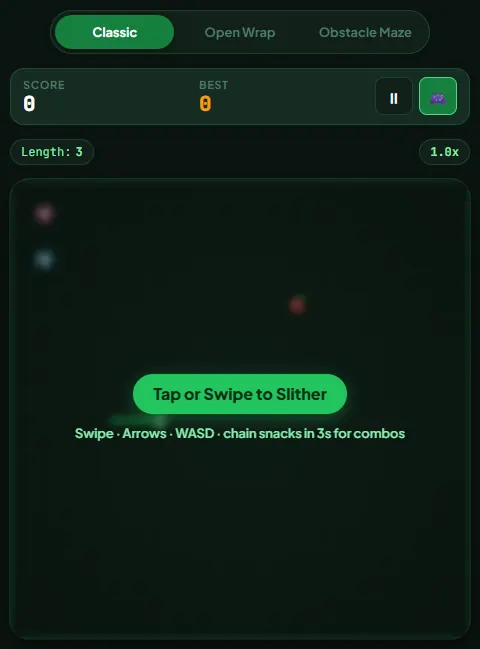
Snack Snake is played on a 20 by 20 grid, 400 cells. You start as a three-segment snake near the left side of the board, heading right. The run begins the moment you give a direction.
- Phone: swipe on the board. A turn commits after about 22 pixels of finger travel, and you do not need to lift your finger, so one continuous drag can chain several turns. There is also an on-screen D-pad you can show or hide.
- Keyboard: arrow keys or WASD to turn, R to restart.
- Auto-pause: if you switch tabs or the window loses focus, the game pauses itself and counts you back in when you return.
Two input rules matter more than they look. First, a 180-degree reverse is ignored, so pressing Left while moving Right does nothing. Second, the game keeps a queue of up to two turns. If you press Up and then Left quickly, both are stored and played on the next two grid steps. That is what makes tight U-turns possible at high speed, and it is also why mashing keys can surprise you: a third press while two are already queued is dropped.
How scoring works
There are four kinds of food. Regular apples are always on the board; the others appear on a schedule and vanish if you leave them too long.
| Snack | Base points | When it appears | Stays on board | Effect |
|---|---|---|---|---|
| Apple | 1 | Always; a new one spawns as soon as you eat one | Until eaten | Grow by one |
| Golden berry | 5 | After every 5th apple | 10 seconds | Grow by one |
| Speed berry | 2 | 25% chance after any other apple | 12 seconds | 6 seconds of faster movement and double points |
| Portal item | 3 | 18% chance if no speed berry rolled | 14 seconds | Moves the portal pair to new spots |
On top of the base value sit two multipliers. The combo: every snack eaten within 3 seconds of the previous one raises the combo by one, up to a cap of x5. The speed boost: while it is active, everything you eat is worth double. They stack, so an apple is worth between 1 and 10 points and a golden berry between 5 and 50.
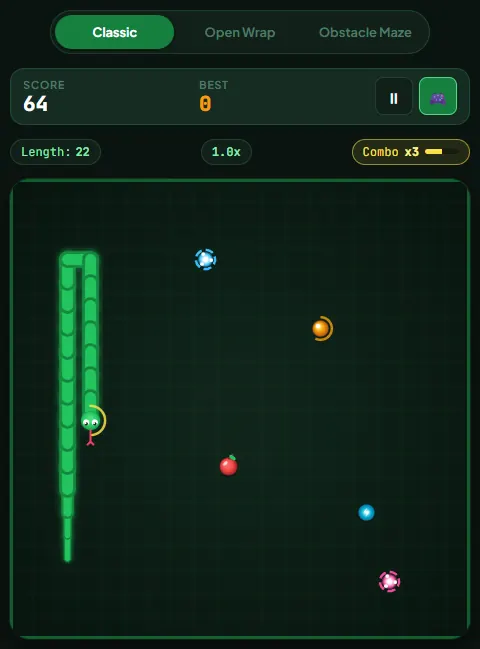
That stacking is the whole high-score game. Plain apple eating at x1 tops out around one point per apple. A player who keeps the combo alive and saves golden berries for boosted windows scores several times more from the same board.
Speed, length and the numbers table
Snack Snake does not have levels. It speeds up as you grow. The game starts at one grid step every 135 milliseconds (about 7.4 cells per second). Every segment beyond the starting three shaves 1.5 ms off that, until it bottoms out at 75 ms (about 13.3 cells per second) when the snake reaches length 43. A speed berry multiplies the step time by 0.65 for 6 seconds, with a hard floor of 50 ms.
| Snake length | Step time | Cells per second | With speed boost |
|---|---|---|---|
| 3 (start) | 135 ms | 7.4 | 88 ms (11.4/s) |
| 13 | 120 ms | 8.3 | 78 ms (12.8/s) |
| 23 | 105 ms | 9.5 | 68 ms (14.7/s) |
| 33 | 90 ms | 11.1 | 59 ms (17.1/s) |
| 43 and longer | 75 ms | 13.3 | 50 ms (20/s) |
Two practical takeaways. The game stops getting faster at length 43, so if you can survive the climb to there, the rest of the run is a pure space-management problem at a constant speed. And a speed berry late in a run nearly doubles your pace for 6 seconds, which is where most long runs actually end.
Strategy, beginner to advanced
1. Know the tail rule
On a normal step, your tail tip moves out of its cell at the same moment your head moves in. Snack Snake respects that: you can move your head into the cell your tail is leaving and survive. The exception is a step where you eat, because the snake grows and the tail stays put. Chasing your own tail in a tight loop is therefore safe as long as there is no food on the cell in front of you.
2. Food never spawns on the outer ring
Snacks spawn only on the inner 18 by 18 area (324 cells) until that area is completely full. The outermost ring of the board never gets food in a normal run. That makes the edge the best place to park body length: segments lying along the wall never sit between you and the next apple, and you will never have to dive to the edge to fetch something.
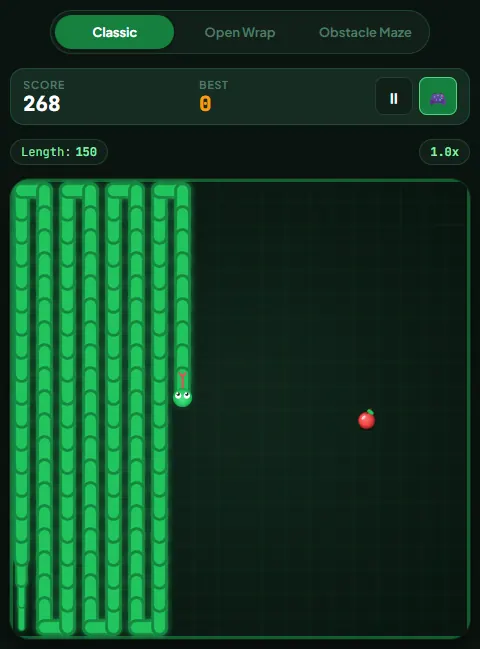
3. Sweep in switchbacks, not loops around the middle
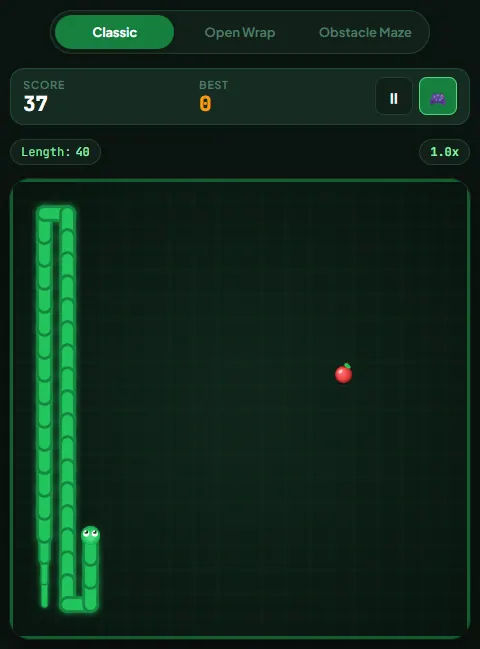
Once the snake is longer than about a quarter of the board width, stop chasing food in curves. Fold your body into parallel lanes against one wall, one column (or row) apart, and travel out to the food along open space. The body behind you stays compact and predictable, and the open side of the board stays one big rectangle instead of a set of pockets.
4. Count before you enter a pocket
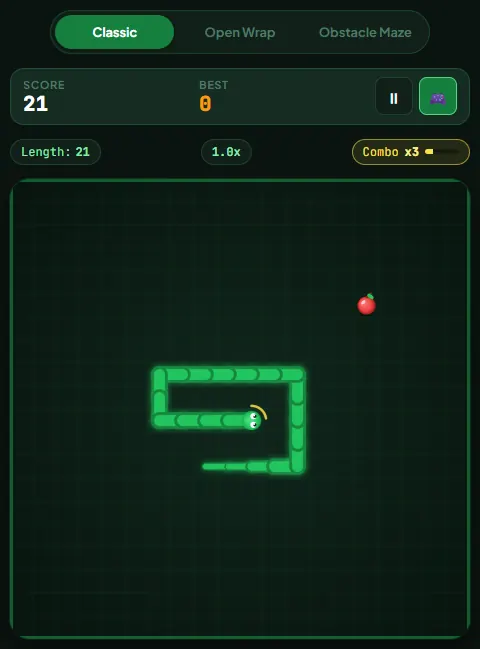
The rule that saves most runs: only enter an enclosed area if the number of free cells inside is larger than the number of steps it will take your tail to open the way out. A quick approximation is "free cells inside versus my length." If the pocket is smaller than your body, do not go in, even for a golden berry.
5. Use the turn queue for U-turns
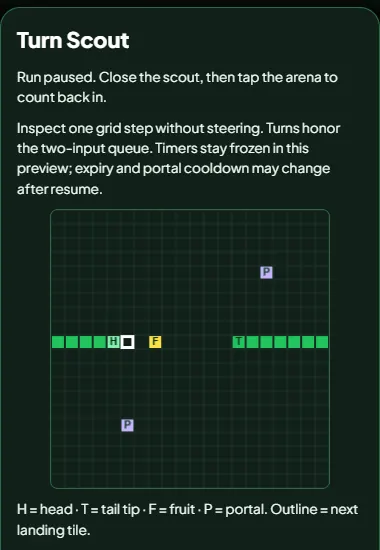
At 75 ms per step you cannot react to each cell. For a 180-degree turn into the next lane, press both turns together, for example Up then Left. Both go into the two-slot queue and play on consecutive steps. On a phone, do the same with one continuous L-shaped drag. The Turn Scout panel under the board pauses the run and shows the next landing cell for any direction, including what the queue will do, which is a good way to learn exactly how the queue behaves.
6. Build combos on purpose
The combo window is 3 seconds. At the starting speed that is about 22 cells of travel; at top speed about 40. A combo therefore lives or dies on how far apart the snacks are. When a golden berry or speed berry is on the board, eat the apple that keeps you closest to it first, so the bonus snack lands inside the window at a higher multiplier.
7. Time the speed berry, then cash in
A speed berry gives 6 seconds of double points. Its own 12-second board timer means you often have a choice of when to take it. Take it when a golden berry or a short run of apples is nearby, not when the board is cramped. Double points do nothing if you spend the 6 seconds escaping your own body at 20 cells per second.
8. Golden berries are worth skipping sometimes
A golden berry lasts 10 seconds. Five points (up to 50 with multipliers) is a lot, but it is never worth entering a pocket you cannot get out of. If reaching it means cutting across your own folded lanes, let it expire. Another one comes after the next five apples.
9. Advanced: the Hamiltonian fallback
Mathematically, a snake that follows a fixed loop through every cell can never crash: the head always moves into the cell the tail has just left. On a 400-cell board that is slow, since each apple can cost hundreds of steps, so nobody plays the full loop from the start. The useful version is a fallback: once your snake is longer than roughly half the board, switch to a loop shape (wall-to-wall switchbacks with a return lane along one edge) and only cut across it when the shortcut ends in a cell well ahead of your tail. That is how full-board clears happen, and Snack Snake does recognise one: fill the board and the run ends with "Board cleared - perfect snake!".
Playing each board mode
Classic. Walls are fatal. Half of all runs also start with a portal pair somewhere on the board. Everything above applies directly.
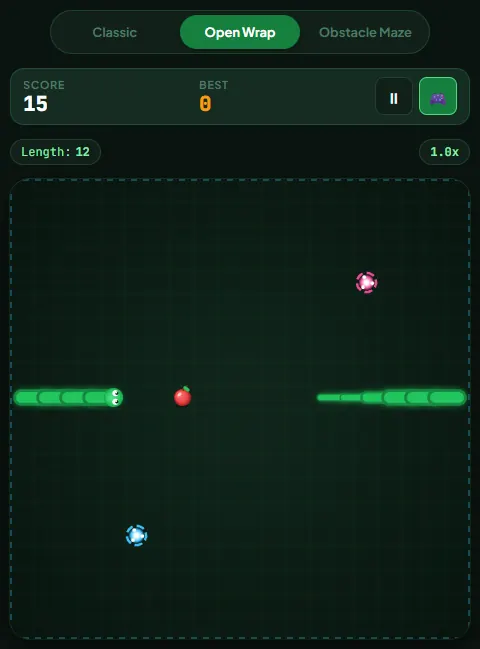
Open Wrap. Leaving one edge brings you in on the opposite edge, and a portal pair always spawns. Wrap is easier early and harder late, because your body ends up split across edges and is easy to forget. Treat the board as a cylinder in one direction only: wrap left-right freely but keep your switchbacks running top to bottom, so the body stays readable.
Portals (all modes when present): enter one and you come out one step beyond the other, still travelling the same direction. After a jump there is a 0.6 second cooldown before portals work again, so you will not bounce straight back. In Obstacle Maze, if the cell beyond the exit portal is a barrier, the jump kills you; check the exit before you dive.
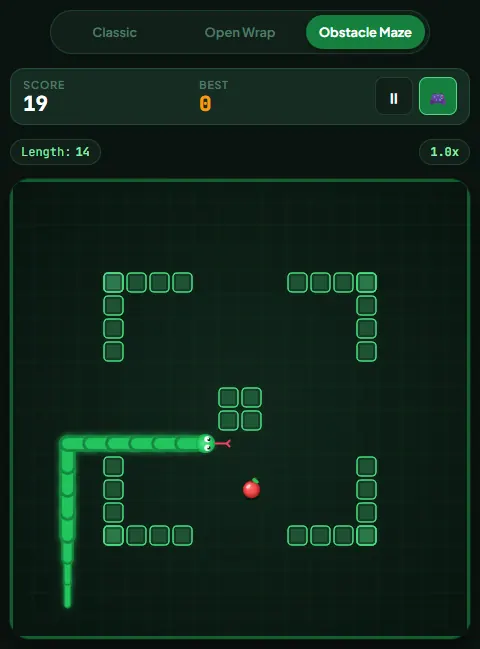
Obstacle Maze. Four L-shaped brackets and a 2 by 2 centre pillar take 32 cells, leaving 368. The brackets make natural walls to fold against, but their inside corners are pockets: do not enter one unless the snake is short. Keep the outer ring as your main highway, which also works with the spawn rule from tip 2.
High scores are kept separately for each mode and saved in your browser, so a Classic record is not overwritten by a Wrap run.
Common mistakes and fixes
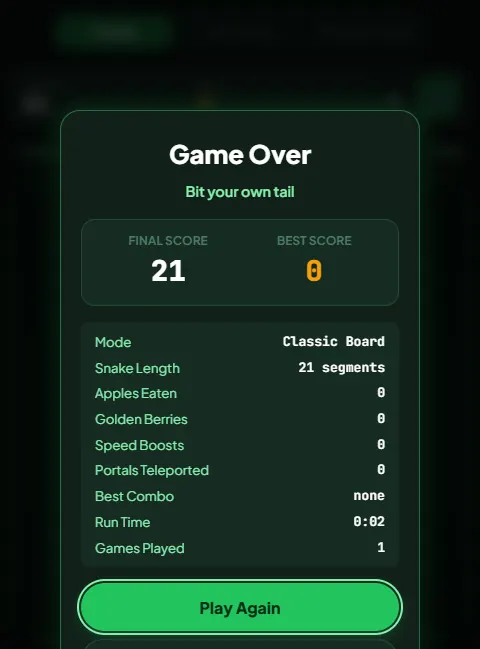
Turning back on yourself. A reverse press is ignored, but a quick Up-then-Left from moving Right is a legal U-turn into the lane next to you. If that lane is your own body, it is a crash. Fix: look one lane over before you queue two turns.
- Chasing food in diagonals. Staircasing toward an apple in the middle leaves a jagged body that cuts the board into pockets. Fix: go straight along a row, then straight along a column.
- Grabbing a speed berry in a crowded board. 6 seconds at up to 20 cells per second is where long runs die. Fix: take it only with open space ahead.
- Forgetting your tail in Wrap mode. Fix: keep folds on one axis and glance at the opposite edge before you cross it.
- Mashing keys. The queue holds two turns. Extra presses are dropped, so the turn you meant last never happens. Fix: one deliberate input per turn, two only for U-turns.
- Playing the middle. Circling the centre leaves no long straight edges to fold against. Fix: start folding against a wall by length 20.
Practice drill. Play three Classic runs where you never eat anything off the straight-line path of your switchbacks, then three where you chase every combo. Compare scores and lengths on the game-over cards; most players find the first approach survives longer and the second scores more per apple. Then mix them.
FAQ
Who made the first snake game?
The genre goes back to Blockade, a two-player arcade game from Gremlin Industries released in 1976. The solo "eat and grow" version is usually traced to Rock-Ola's Nibbler from 1982.
Which Nokia phone had Snake first?
The Nokia 6110, in 1997. The game was programmed by Taneli Armanto. Snake II followed on the Nokia 3310 in 2000.
Does Snack Snake get faster?
Yes, by length rather than by level. It starts at 135 ms per step and speeds up 1.5 ms per segment until it hits 75 ms at length 43. Speed berries make it faster still for 6 seconds.
Can you hit the wall in Open Wrap mode?
No. Edges wrap to the opposite side. Your own body is still fatal, and in Classic and Obstacle Maze the wall ends the run.
How do combos work?
Eat any snack within 3 seconds of the last one and the combo goes up by one, to a maximum of x5. Points are base value times combo, doubled again during a speed boost.
Can you actually win at snake?
Yes. In Snack Snake, if there is no free cell left for a new apple, the run ends as "Board cleared - perfect snake!". It takes a loop-style route through the whole board to get there.
Is my high score saved?
Yes, locally in your browser, with a separate best score for each of the three modes. Clearing site data resets it.
Try the switchback and the pocket-count rule on a real board. Three modes, no install.
Play Snack Snake