Spider uses two decks, 104 cards, laid out in ten columns. Only the bottom card of each column starts face up. Your job is to build eight complete runs of one suit, King down to Ace. Each time you finish one, it lifts off the table and scores 100 points. Clear all eight and you win.
You can place any card on a card exactly one rank higher, whatever the suit: a 6 of hearts goes on a 7 of spades. But you can only pick up a stack as a unit when it is all one suit and runs in order. That gap between "can place" and "can carry" is what makes the game hard. Pile a 5 of clubs on a 6 of hearts and you have a stack you can't lift without taking it apart first.
When you run out of useful moves, tap the stock in the top-left corner. It deals one card face up onto every column. You can't deal while any column is empty, so put a card in each gap first. Five deals sit in the stock, 50 cards in all.
Choosing 1, 2 or 4 suits
1 suit is spades only. Nearly every deal can be won, which makes it a good place to learn the rhythm and practise emptying columns.
2 suits mixes spades and hearts. You need to think about which suit you are building on, and you will sometimes have to park a card on the wrong suit and fix it later.
4 suits is the full game. Expect to win a fraction of your deals even when you play well. Careful undo use and patience matter more than speed.
Coin rewards scale with the mode: a 2-suit win pays double and a 4-suit win pays four times the 1-suit amount, up to the daily limit shown after each win.
Strategy that actually helps
Empty a column early
An empty column is the most valuable thing on the board. It lets you shuffle a stack out of the way and hold a King or a long run while you dig. Aim at the shortest column first, especially one that is mostly face-up cards.
Turn over face-down cards before you tidy
Every hidden card is unknown information. A move that flips one over usually beats a move that merely neatens a stack. The hint button leans the same way.
Build on the same suit when you have a choice
If a 7 can go on two different 8s, pick the one in its own suit. Same-suit stacks move together later; mixed stacks lock cards in place. If you see one dealt row that lands suited cards onto the right targets, that is a good time to deal.
Don't deal on autopilot
Before tapping the stock, look for moves that open a column or turn a card over. Once ten new cards land on top, some of them bury cards you needed.
Use undo like a scout
Undo is unlimited. Try a line two or three moves deep, see what it reveals, and step back if it leads nowhere. It costs a point each time and cancels the no-undo bonus, but a lost 4-suit game costs far more.
Controls and scoring
Tap a card to move it to the obvious destination. If two equally good destinations exist, the card is selected, the targets glow, and a second tap on the target finishes the move. You can also drag a stack with a finger or mouse. On a keyboard, U or Z undoes, H shows a hint, D deals and N starts a new game.
Your score starts at 500, loses 1 for each move, deal or undo, and gains 100 for each finished run. A tidy win lands somewhere around 1,000 to 1,150. Your best time, win percentage and streak are tracked separately for each suit mode on the Stats screen.
Questions
Why can't I deal a new row?
Standard rules block a deal while any column is empty. Put a card into every empty column, then tap the stock again.
Which mode should I start with?
One suit. You will learn how runs form and why empty columns matter without fighting the odds. Move up to two suits when you win most of your one-suit games.
Can every deal be won?
No. In one-suit mode almost all deals are winnable, but a share of four-suit deals cannot be solved no matter how well you play. Start a fresh deal when a game is clearly stuck.
Does undo cost points?
Yes, one point, the same as the classic Windows version. A win with no undos and no hints pays a bonus.
Is my game saved?
The game in progress, your stats and your settings are kept in this browser. Clearing site data removes them.
Spider Solitaire guide · rules, scoring, one, two and four suits
Spider Solitaire: How This Version Works and How to Win More Games
Spider is solitaire with two decks, ten columns and one goal: build eight complete runs from King down to Ace, each in a single suit. This version lets you pick one, two or four suits before you deal. The cards are the same in every mode, so the only thing that changes is how hard it is to keep a run clean. This guide covers the exact rules the game enforces, how the score is calculated, and the habits that decide whether a board comes together or locks up.
Numbers on this page (deal sizes, score changes, undo behaviour, hint logic) were read from the game's own code.
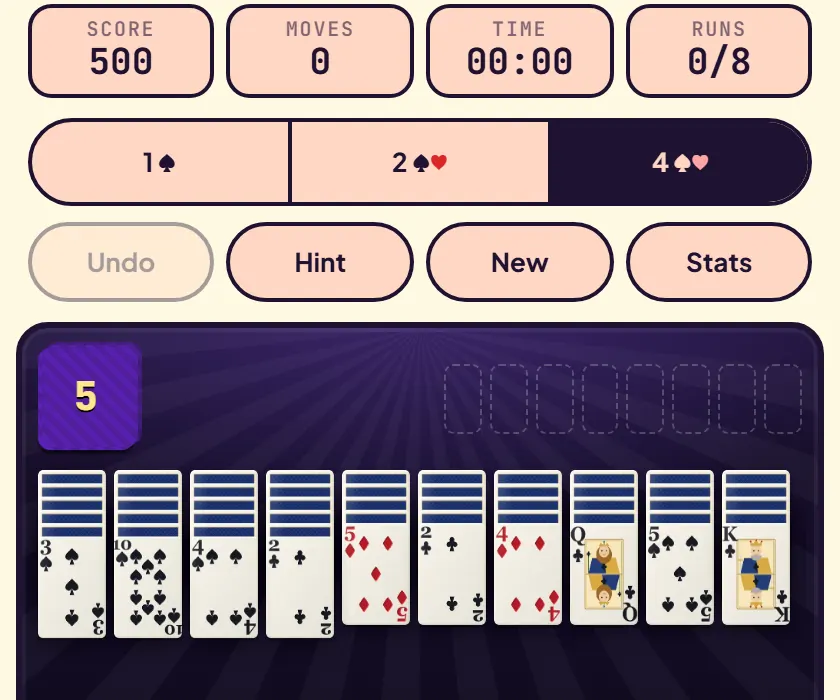
A fresh four-suit deal. Ten columns, one face-up card on each, a stock marked 5, and eight empty slots at the top right that fill as you finish runs.
The deal and the layout
The game uses 104 cards: eight sets of Ace to King. The first four columns get 6 cards each and the last six columns get 5 each, which is 54 cards. Only the bottom card of each column is face up. The other 50 cards sit in the stock, which is exactly five deals of ten.
The shuffle is random every time you start a game. There is no deal number to replay, so you cannot go back to a board you liked. A game in progress is saved on your device and resumes where you left it.
Along the top you see the score, moves, a clock and a runs counter that reads 0/8 at the start. The clock starts on your first move or deal, not when the cards land. The slots at the top right fill one by one as each finished run leaves the table. The number on the stock pile is how many deals you have left.
What you can and cannot move
Two rules do almost all the work, and they are deliberately different from each other.
Placing is loose. A card or a stack can go onto a card exactly one rank higher, in any suit. A red 6 goes on a black 7. A spade 6 goes on a spade 7. Both are legal.
Lifting is strict. You can only pick up a stack if every card in it is face up, the same suit, and descends by exactly one rank. A 9♠ 8♠ 7♠ stack moves as one piece. In a 9♠ 8♥ 7♠ column you can only pick up the 7♠ on its own, because the suit changes at the 8.
The second rule is what makes Spider hard. You can drop cards onto a mixed-suit sequence all day, but you cannot move that sequence as a unit until you rebuild it by suit. Every off-suit placement is a loan against a column you will have to untangle later.
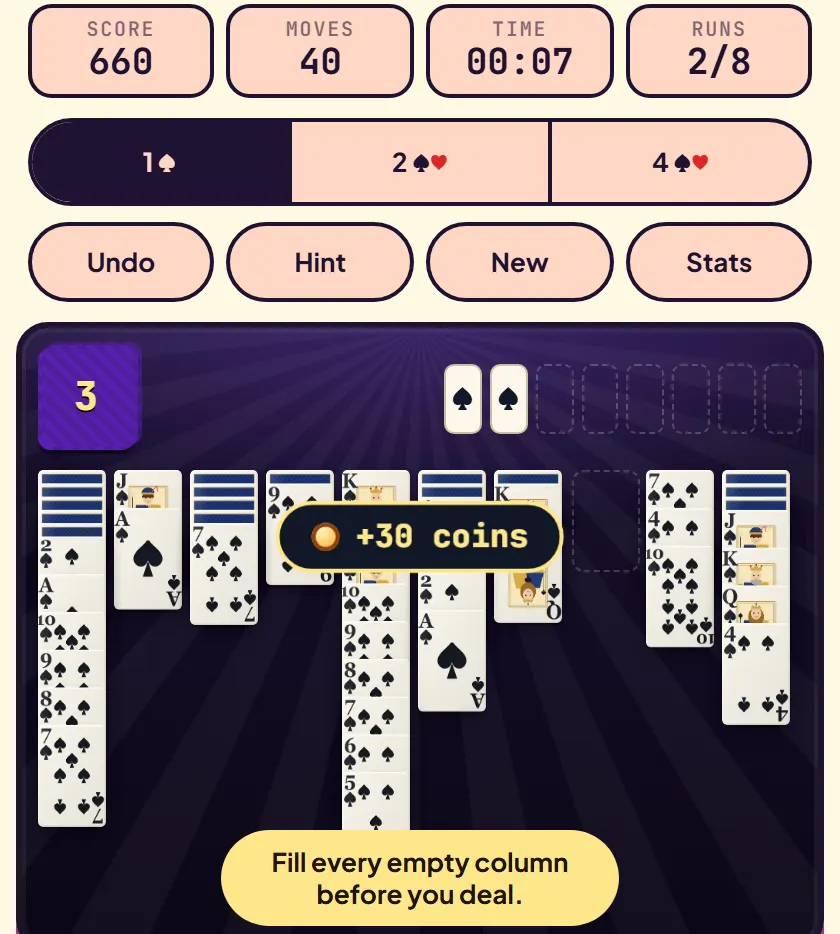
Two more rules. Any card or movable stack may go into an empty column. And you may only deal from the stock when every column has at least one card. If you try to deal with a gap, the game refuses with "Fill every empty column before you deal" and shakes the empty slots. That is the standard rule, and it matters more than it sounds (see the strategy section).
When a King-to-Ace run in one suit sits at the bottom of a column, the 13 cards fly to the top slots and the card under them turns face up. If a deal happens to finish a run, it is swept automatically as well.
Move 40, two runs done, three deals left. The empty column is useful for staging cards, but the toast shows you cannot deal until something is in it.
One, two and four suits
The suit buttons above the board change what the eight sets of Ace to King are made of.
What each suit setting deals
Mode
Suits in the 104 cards
What it feels like
1 suit
8 sets of spades
Every descending stack is movable. The puzzle is mostly about flipping cards and keeping columns open.
2 suits
4 sets of spades, 4 sets of hearts
Half of your placements are off-suit. You have to start choosing which suit to build where.
4 suits
2 sets each of spades, hearts, clubs, diamonds
Off-suit chains are the norm. Every move is a trade-off, and no board is guaranteed to be winnable.
Changing the setting while a game is under way asks first: the current game counts as a loss and ends your streak, then a fresh deal starts. Wins, played games, win percentage, best time and streak are tracked separately for each of the three modes on the Stats screen. If you are new, play one suit until you can clear it without hints, then move to two. Going straight to four suits mostly teaches frustration.
There is also a four-colour suits setting, on by default. In a two or four suit game it is worth keeping on: telling a black club from a black spade at a glance is half the battle.
Scoring, undo and hints
Score is simple arithmetic.
You start at 500.
Every move costs 1 point. Moving a card or stack is a move, and dealing a row counts as a move too.
Every finished run adds 100.
The score never goes below zero.
So the best a game can pay is 500 plus 800 for the eight runs, minus however many moves you took. A win in 150 moves finishes on 1,150. A one-suit win in the testing for this guide took 195 moves and ended on 1,105, which matches the formula exactly.
Final score of a won game by number of moves
Moves taken
Final score
150
1,150
200
1,100
300
1,000
500
800
1,300 or more
0
A point per move is small next to a run, so the score rewards efficiency without punishing you for thinking. The clock and the move counter are what tell you how clean a win was.
Undo is unlimited, but it is not free
You can undo as many times as you like, with the Undo button or U or Z on a keyboard. Each undo restores the board but still costs a point on top of the move it reverses, so taking back a single move leaves you 2 points lower than before you made it. If you close the tab and come back, the saved game keeps the last 80 steps of history, so you can still undo a few moves after a reload.
There is one more catch if you collect coins on this site: a win with no undos and no hints pays an extra "perfect" bonus. If you care about that, treat undo as a tool for experiments, not a crutch.
How the hint thinks
Hint runs a short search, about 120 milliseconds, over legal moves and stock deals. It scores positions by joined runs (a same-suit link counts more than an off-suit one), how many cards are still face down, and finished runs. Two details are worth knowing:
The search sees the whole layout, including the face-down cards and the order of the stock. A hint can therefore be better than anything you could know from the table. Treat it as a coach, not as a neutral opinion.
Pressing Hint again cycles through the next-best alternatives, and it never suggests simply taking back the move you just made. If it finds nothing it tells you so, which is often a sign to undo a few moves.
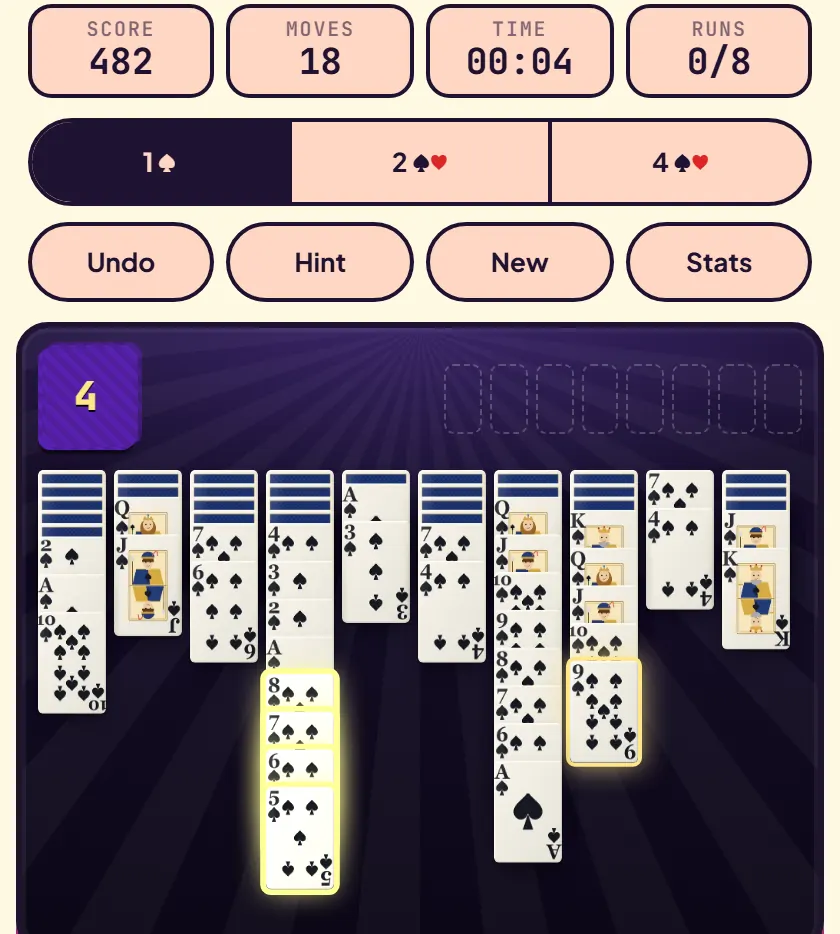
A hint at move 18: lift the 8-7-6-5 stack from column 4 and put it on the 9 in column 8. Both the stack and its destination glow.
Strategy that holds up
None of this is secret, but most losses come from ignoring one of these and hoping.
Uncover face-down cards first. Every flipped card is information and a new legal move. When two moves look equal, pick the one that exposes a hidden card, preferably in the column with the most hidden cards left. The first four columns start with five hidden cards each, the others with four.
Build in suit whenever you can. If you can place a 6 on a 7 of the same suit, do that and not the off-suit 7. A same-suit build is a stack you can still move. An off-suit build is not.
Do not rush the stock. Each deal drops ten cards on top of ten columns and buries your positions under cards you did not choose. Exhaust useful moves first. But do not be afraid of a deal when you are genuinely stuck: it is the only way to get new cards into play.
Treat an empty column as an asset. It lets you reposition any stack. Using the gap to move a blocking stack off a face-down card is usually better than dropping the nearest loose card in and losing the space.
Know the deal rule before you clear a column. Because you cannot deal with a gap, clearing a column right before a deal means you must have a card ready to fill it. A single low card parked somewhere easy to reach does the job.
Remember what a King can do. Nothing is one rank above a King, so a King can only ever move into an empty column. A King sitting on top of face-down cards in a column traps them until you have an empty column to move it to. Plan for that before you bury it.
Do not break a joined run to chase a flip. If a same-suit run is already linked, splitting it to reach a face-down card undoes your own work. The game's own destination ranking penalises that move, and so should you, unless the card underneath is critical.
Use undo like a scratch pad. Try the move, look at what it exposed, and take it back if the position got worse. The cost is two points, which is much cheaper than a lost game.
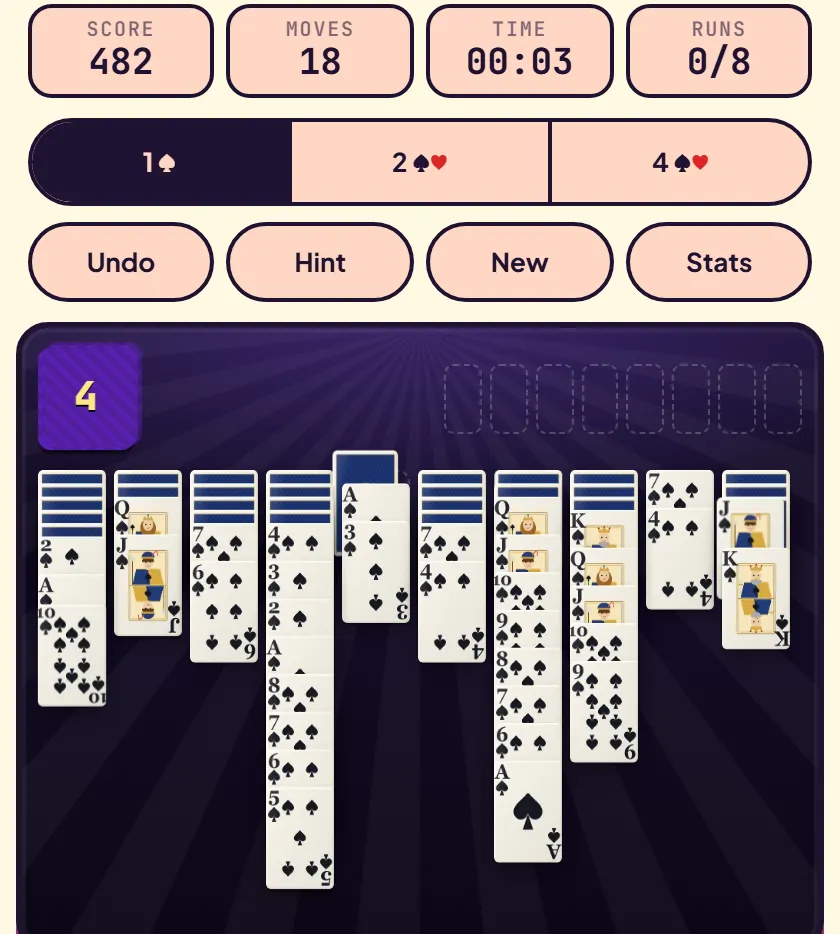
A healthy one-suit middle game: long stacks in one suit, face-down cards running low, and no deal needed yet.
Tap and drag controls
You can drag any movable stack, or tap a card. With one-tap moves on, tapping sends the card or stack to the best destination when there is a single clear answer, and shows you the targets when there are several. Tapping the selected stack again takes the best move. The game ranks destinations in a simple order: same-suit placement beats off-suit, a move that flips a hidden card or empties a column ranks higher, and moving a whole column into an empty one is never offered. Keyboard shortcuts are U or Z to undo, H for hint, D to deal and N for a new game.
One-tap is fast, but in a two or four suit game you may want it off (it is a checkbox on the Stats screen) so that every placement is your own decision.
Common mistakes
Mistake
Why it hurts
Fix
Dealing with moves still available
Ten new cards bury your tidy columns and make every stack longer to untangle
Check every column bottom for a move, a flip or an empty-column play before you deal
Putting any card into an empty column at once
You lose your only flexible space
Use the gap to stage a stack, then fill it with something that frees a hidden card
Building off-suit chains in a four-suit game
The chain cannot be lifted as a unit
Choose a main suit for each column and avoid putting a different suit on top unless it frees something
Leaving a column empty before a deal
The game blocks the deal until you fill it
Keep a spare card ready, or fill the gap before you need the stock
Ignoring the stock count
Five deals go quickly, and each one adds ten cards on top
Aim to flip as many hidden cards as you can before each deal
Using hints on every move
The hint can see hidden cards and plays differently than you can; you stop learning the position
Use it when stuck, then work out why that move was better
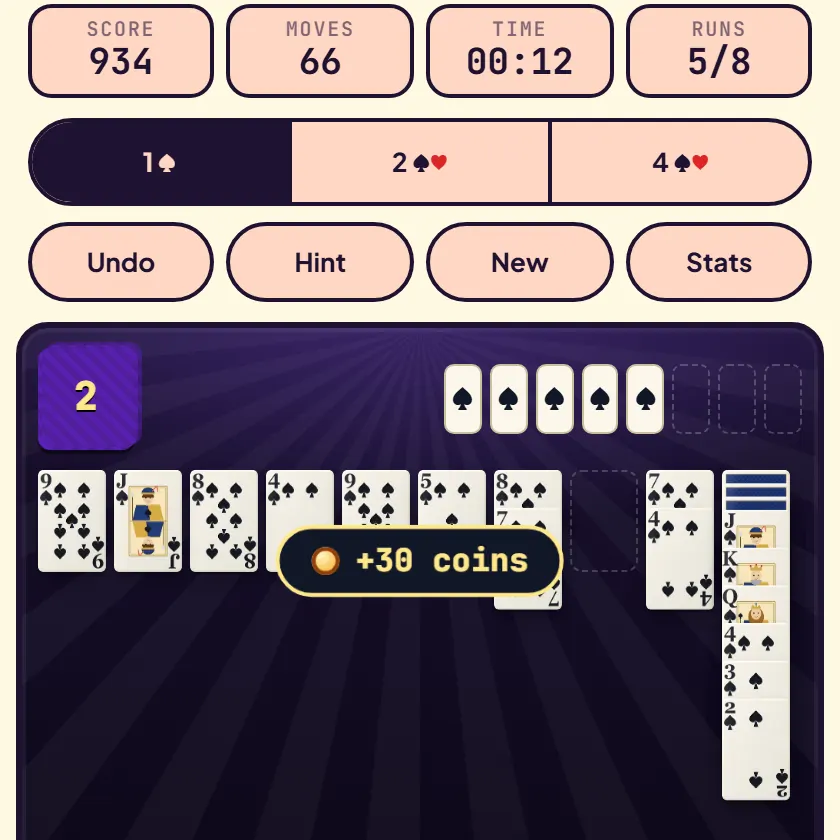
Five of eight runs done at move 66: 500, minus 66 moves, plus 500 for the runs is 934. The stock still shows 2 deals.
FAQ
Can I deal when a column is empty?
No. Every column needs at least one card before a deal. If you try, the game shows a message and shakes the empty slots. Move any card into the gap, then deal.
Why can I not move a stack that looks in order?
To lift a stack, every card in it must be face up, the same suit, and exactly one rank below the card above it. A 9, 8, 7 that changes suit is not a stack. You can still lift the bottom card alone if it has somewhere to go.
Is every game winnable?
Not necessarily. The deal is a random shuffle and nothing checks solvability beforehand. When no legal move or deal remains, the game tells you to undo or start again. One-suit boards are the most forgiving; four-suit boards often are not.
Does closing the page lose my game?
No. The game saves to your browser on this device as you play and when the page is hidden, and it resumes on reload. If you clear site data or switch browsers, the saved game does not follow you.
What happens if I start a new game halfway through?
You get a confirmation first. A game you have started but not finished counts as a loss for that suit mode and ends your win streak.
What does the Stats screen track?
For each of the one, two and four suit modes: games played, games won, win percentage, best time, and current and best win streak.
Deal a one-suit game, uncover the column with the most hidden cards first, and see how long you can go before you need the stock.