Free 21 card game · rules, strategy chart, tips
How to Play Blackjack 21 (and Play It Well)
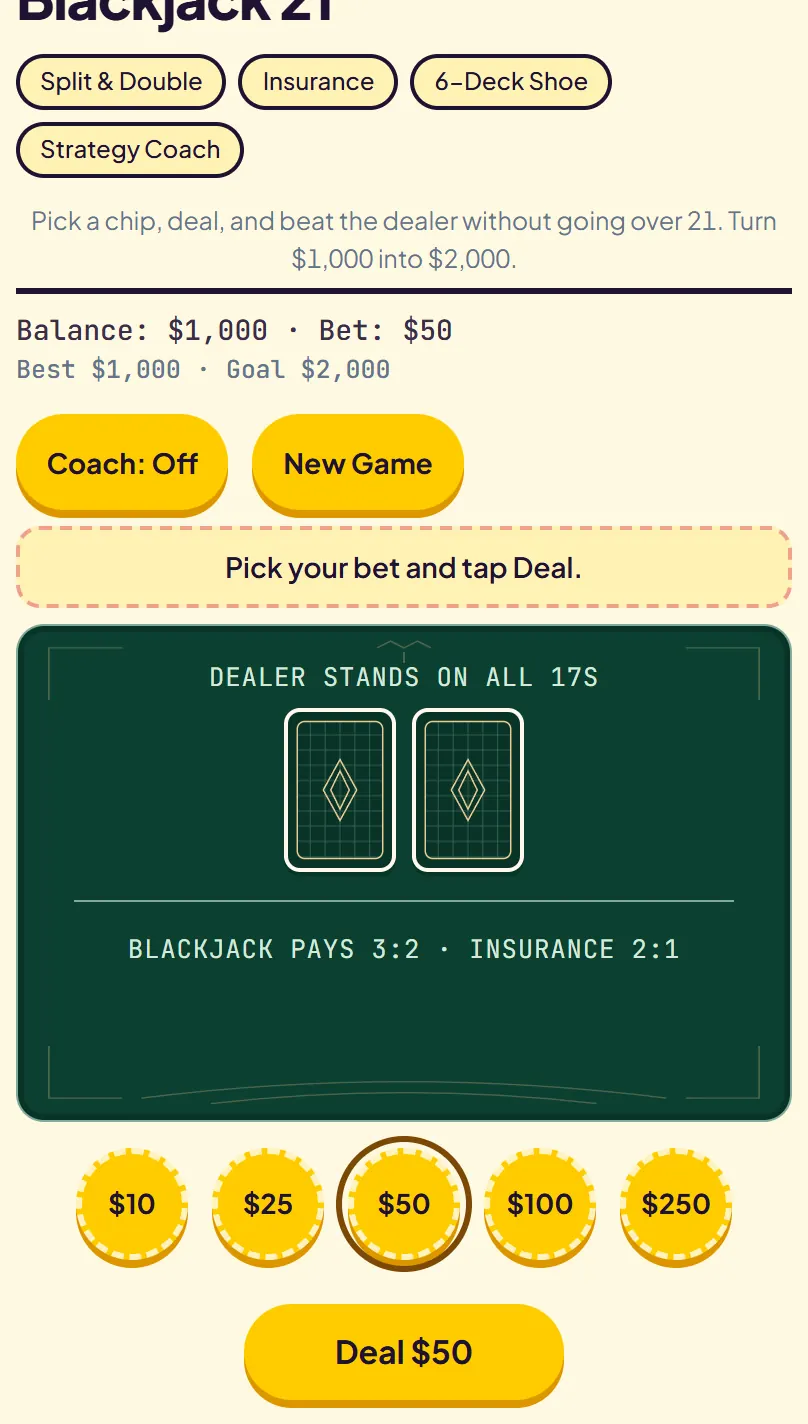
This table deals from a six-deck shoe, the dealer stands on every 17, blackjack pays 3:2, and you can double after splitting. Those four facts decide the correct play in every hand, so this guide uses them for the chart below. You play with practice chips only: you start with $1,000 of pretend money, and the aim is to reach $2,000 before the stack hits zero.
The table rules
Every blackjack game has its own house rules, and basic strategy shifts a little with each one. Here is exactly what this table does:
| Rule | This game |
|---|---|
| Decks | 6 (a 312-card shoe, shuffled fresh when it runs low) |
| Dealer on soft 17 | Stands. The dealer draws only while below 17. |
| Dealer peek | Yes. With an Ace or a 10-value card up, the dealer checks for blackjack before you act. |
| Blackjack pays | 3:2 (rounded down to whole dollars) |
| Double down | On any first two cards, one card only |
| Double after split | Allowed (except on split Aces) |
| Split | Any two cards of equal value, up to 4 hands |
| Split Aces | One card each, no further splitting or doubling |
| Insurance | Offered on a dealer Ace, costs half your bet, pays 2:1 |
| Surrender | Not offered |
| Bet sizes | $10, $25, $50, $100, $250 (one chip per hand) |
| Start / goal | $1,000 practice stack / reach $2,000 |
The shoe counter in the corner of the felt shows how many cards are left. The game reshuffles once the shoe drops below a cut point set at a quarter of the shoe plus a random 0 to 19 cards, so roughly 78 to 97 cards are never dealt from each shoe. That buffer, plus the random cut, is one reason card counting is not worth the effort here.
Splitting goes by value, not rank. A King and a 10 count as a pair, and so do a Jack and a Queen.
How a round plays out
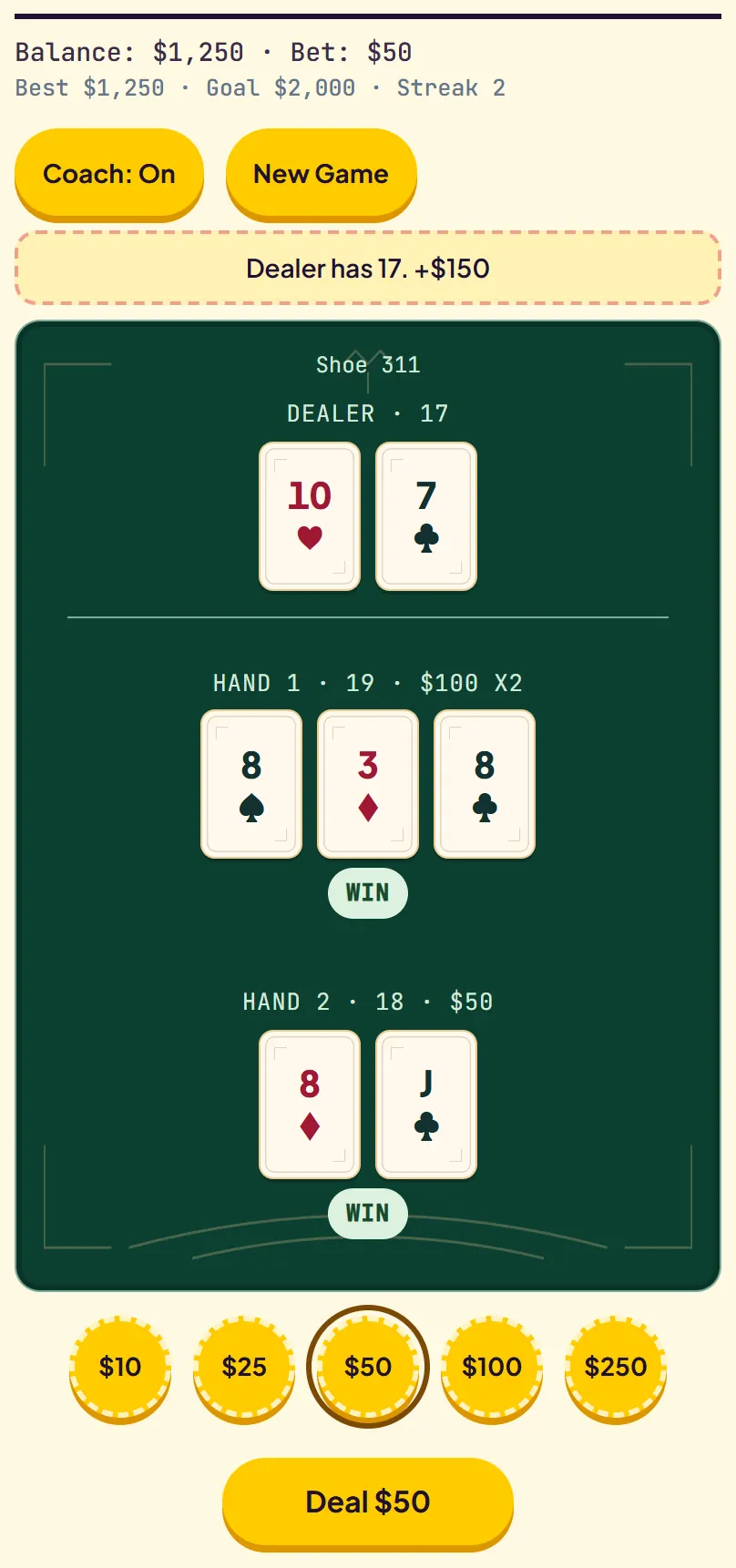
- Pick a chip and deal. Tap a chip (or press 1 to 5), then Deal (or Enter). Your bet leaves the balance immediately, which is why the balance drops the moment cards come out.
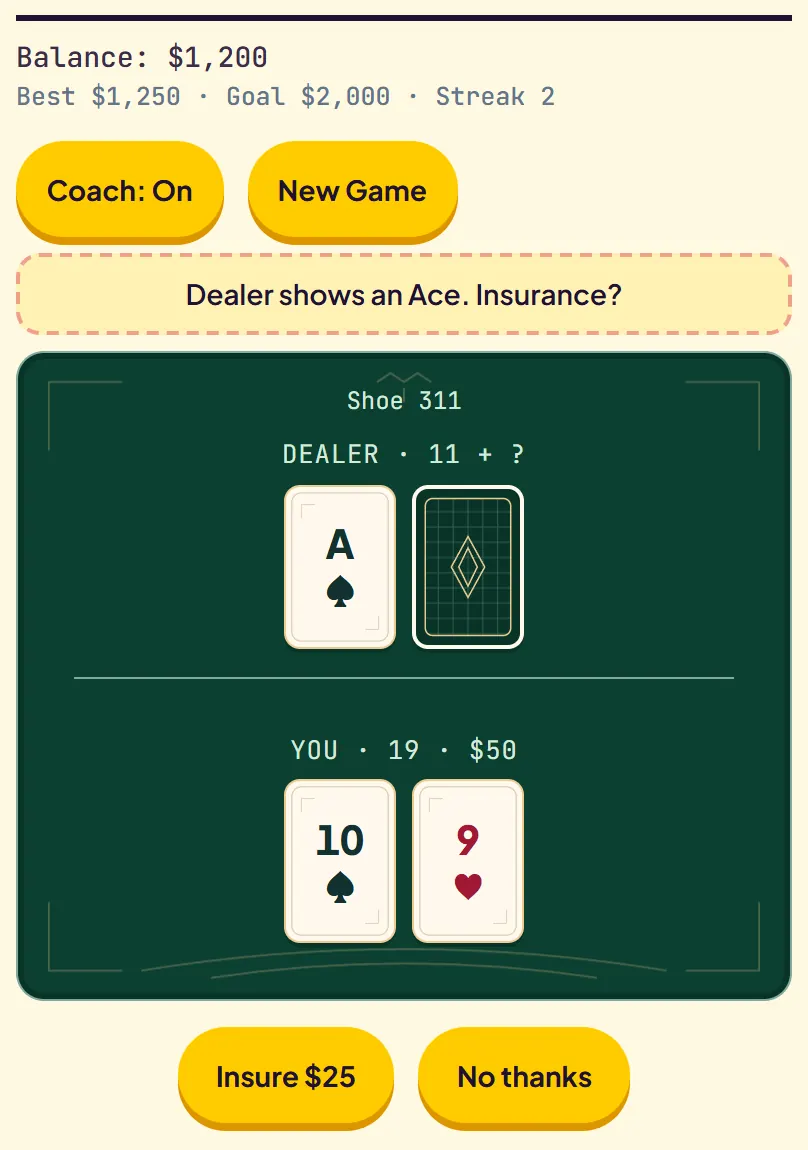
- Insurance, if the dealer shows an Ace. You get Insure or No thanks (Y or N). If you already hold blackjack, the offer is skipped.
- The peek. If the upcard is an Ace or a ten, the dealer checks the hole card. A dealer blackjack ends the round right there, and you lose only your original bet.
- Your turn. Hit (H), Stand (S), Double (D) or Split (P). A hand that reaches exactly 21 stands on its own.
- The dealer's turn. The hole card flips and the dealer draws until reaching 17 or more, soft or hard. If every one of your hands has busted, the dealer does not bother drawing.
- Settle. Each hand is paid separately, tagged WIN, LOSE, PUSH, BUST or BLACKJACK.
Payouts and chip math
Wins pay 1:1, so a $50 bet returns $100 (your $50 plus $50). A natural blackjack, an Ace with a ten on your first two cards, pays 3:2. The game rounds the bonus down to the nearest dollar, so the chip you pick changes the exact payout:
| Bet | Regular win | Blackjack (3:2) | Insurance cost | Insurance win (2:1) |
|---|---|---|---|---|
| $10 | +$10 | +$15 | $5 | +$10 |
| $25 | +$25 | +$37 | $12 | +$24 |
| $50 | +$50 | +$75 | $25 | +$50 |
| $100 | +$100 | +$150 | $50 | +$100 |
| $250 | +$250 | +$375 | $125 | +$250 |
The $25 chip is the odd one out: its blackjack pays $37, not $37.50, and its insurance costs $12. Over a short session that rounding is a few dollars, but if you are chasing the $2,000 goal on $25 bets, it is a small reason to prefer $10, $50 or bigger chips.
Some details that trip people up:
- Blackjack against dealer blackjack is a push. Your bet comes back.
- 21 after a split is not blackjack. Split a pair of Aces, catch a King, and the hand pays 1:1 like any other 21.
- The peek protects doubles and splits. Because the dealer checks for blackjack first, you never put extra chips out and then lose them to a dealer natural.
Basic strategy chart for these rules
Basic strategy is the mathematically best play for every combination of your hand and the dealer's upcard, worked out by computer analysis decades ago. It does not guarantee a win. It loses less, over time, than any other way of playing. With this table's rules (6 decks, dealer stands on soft 17, double after split, no surrender), following it keeps the house edge well under one percent.
How to read it: find your hand on the left, the dealer's upcard across the top. H = hit, S = stand, D = double if you can, otherwise hit, Ds = double if you can, otherwise stand, P = split.
Hard totals (no Ace, or an Ace that must count as 1)
| You | 2 | 3 | 4 | 5 | 6 | 7 | 8 | 9 | 10 | A |
|---|---|---|---|---|---|---|---|---|---|---|
| 8 or less | H | H | H | H | H | H | H | H | H | H |
| 9 | H | D | D | D | D | H | H | H | H | H |
| 10 | D | D | D | D | D | D | D | D | H | H |
| 11 | D | D | D | D | D | D | D | D | D | H* |
| 12 | H | H | S | S | S | H | H | H | H | H |
| 13 to 16 | S | S | S | S | S | H | H | H | H | H |
| 17 or more | S | S | S | S | S | S | S | S | S | S |
*Hard 11 against an Ace is the one cell where the in-game Coach differs from the published chart. Standard charts for a dealer who stands on soft 17 say hit; the Coach says double, and grades a double as the correct move. The two plays are almost identical in value, so either is fine. Just know that the Coach will mark a hit here as a miss.
Soft totals (an Ace counting as 11)
| You | 2 | 3 | 4 | 5 | 6 | 7 | 8 | 9 | 10 | A |
|---|---|---|---|---|---|---|---|---|---|---|
| A,2 / A,3 | H | H | H | D | D | H | H | H | H | H |
| A,4 / A,5 | H | H | D | D | D | H | H | H | H | H |
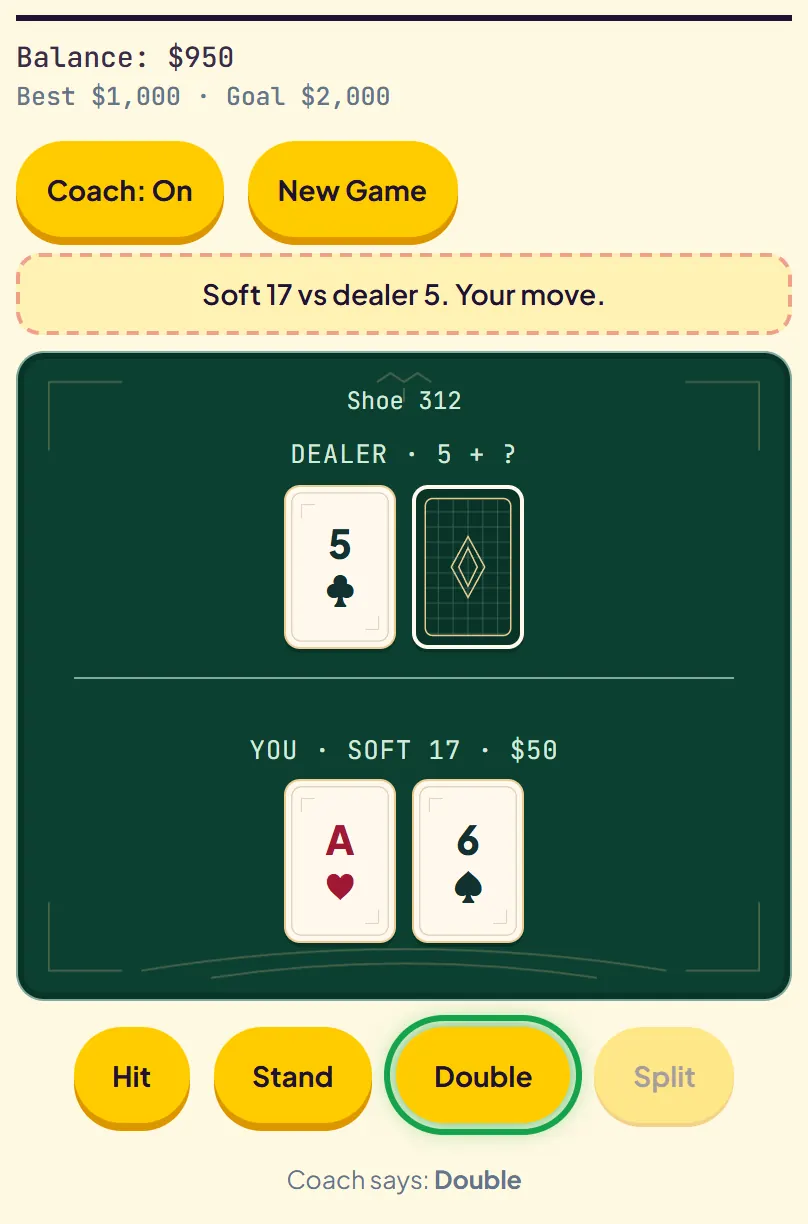
| A,6 (soft 17) | H | D | D | D | D | H | H | H | H | H |
| A,7 (soft 18) | S | Ds | Ds | Ds | Ds | S | S | H | H | H |
| A,8 or more | S | S | S | S | S | S | S | S | S | S |
Pairs
| You | 2 | 3 | 4 | 5 | 6 | 7 | 8 | 9 | 10 | A |
|---|---|---|---|---|---|---|---|---|---|---|
| A,A | P | P | P | P | P | P | P | P | P | P |
| 10,10 | S | S | S | S | S | S | S | S | S | S |
| 9,9 | P | P | P | P | P | S | P | P | S | S |
| 8,8 | P | P | P | P | P | P | P | P | P | P |
| 7,7 | P | P | P | P | P | P | H | H | H | H |
| 6,6 | P | P | P | P | P | H | H | H | H | H |
| 5,5 | D | D | D | D | D | D | D | D | H | H |
| 4,4 | H | H | H | P | P | H | H | H | H | H |
| 3,3 / 2,2 | P | P | P | P | P | P | H | H | H | H |
Once a hand has three or more cards, doubling is gone, so the D cells become hits and the Ds cells become stands. A pair you cannot split (because you already have four hands, or not enough chips) plays as its hard total: 7,7 becomes hard 14, 9,9 becomes hard 18.
The chart in plain words
You do not need to memorize all 210 cells. Most of the chart follows from one idea: the dealer's upcard tells you how likely the dealer is to bust. A dealer showing 2 through 6 has to keep drawing on totals like 12 to 16 and busts often. A dealer showing 7 through Ace usually finishes on 17 or better.
- Stiff hands (12 to 16): stand against 2 to 6 and let the dealer take the risk; hit against 7 or higher, because standing on 15 against a likely 17 loses most of the time. The exception is 12, where you hit against a 2 or 3.
- Double when you are ahead of the dealer: 10 and 11 against weaker upcards, 9 against 3 to 6, and the soft hands against 4 to 6.
- Always split Aces and 8s. Two hands starting with an Ace are far better than one soft 12, and 16 is the worst total in the game, while 8 is a decent start.
- Never split 10s or 5s. 20 is a winning hand; a pair of 5s is a 10 you should double.
- Soft hands cannot bust on one card, so hit or double them freely. Soft 18 is the tricky one: double against 3 to 6, stand against 2, 7 and 8, hit against 9, 10 and Ace.
Strategy, beginner to advanced
Beginner
- Learn the stiff-hand rule first. 13 to 16: stand against 2 to 6, hit against 7 to Ace. That single line fixes more losing play than anything else.
- Always say no to insurance. In a six-deck shoe, once the dealer shows an Ace there are at most 96 tens among the 311 unseen cards, so the hole card is a ten only about 31% of the time. Insurance pays 2:1, which only breaks even at 33.3%. It is a side bet that loses over time, and that includes insuring your own 20.
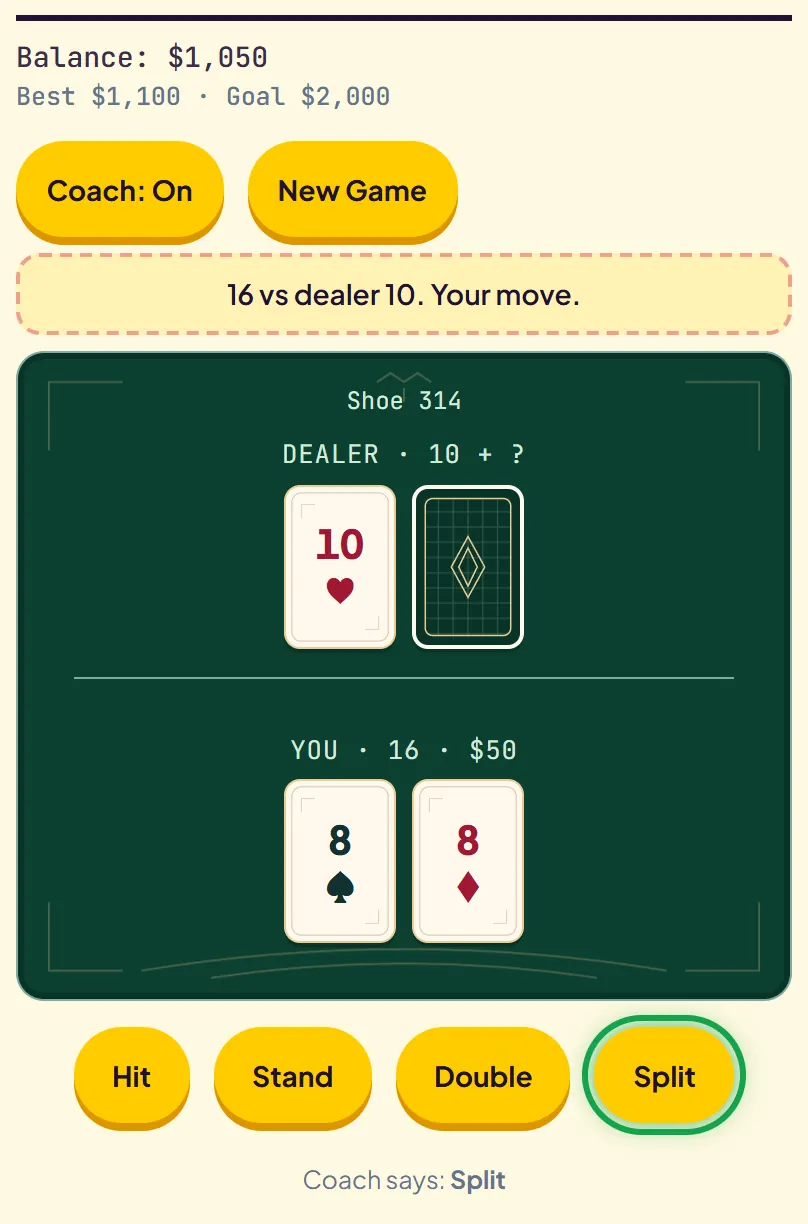
- Treat 16 against a 10 as a hit. It feels awful, and you will bust often, but standing loses even more, because a dealer with a ten up rarely ends below 17.
Intermediate
- Split 8s even against a 10 or Ace. You are trading one terrible hand for two mediocre ones. You will still lose more than you win in that spot; you just lose less.
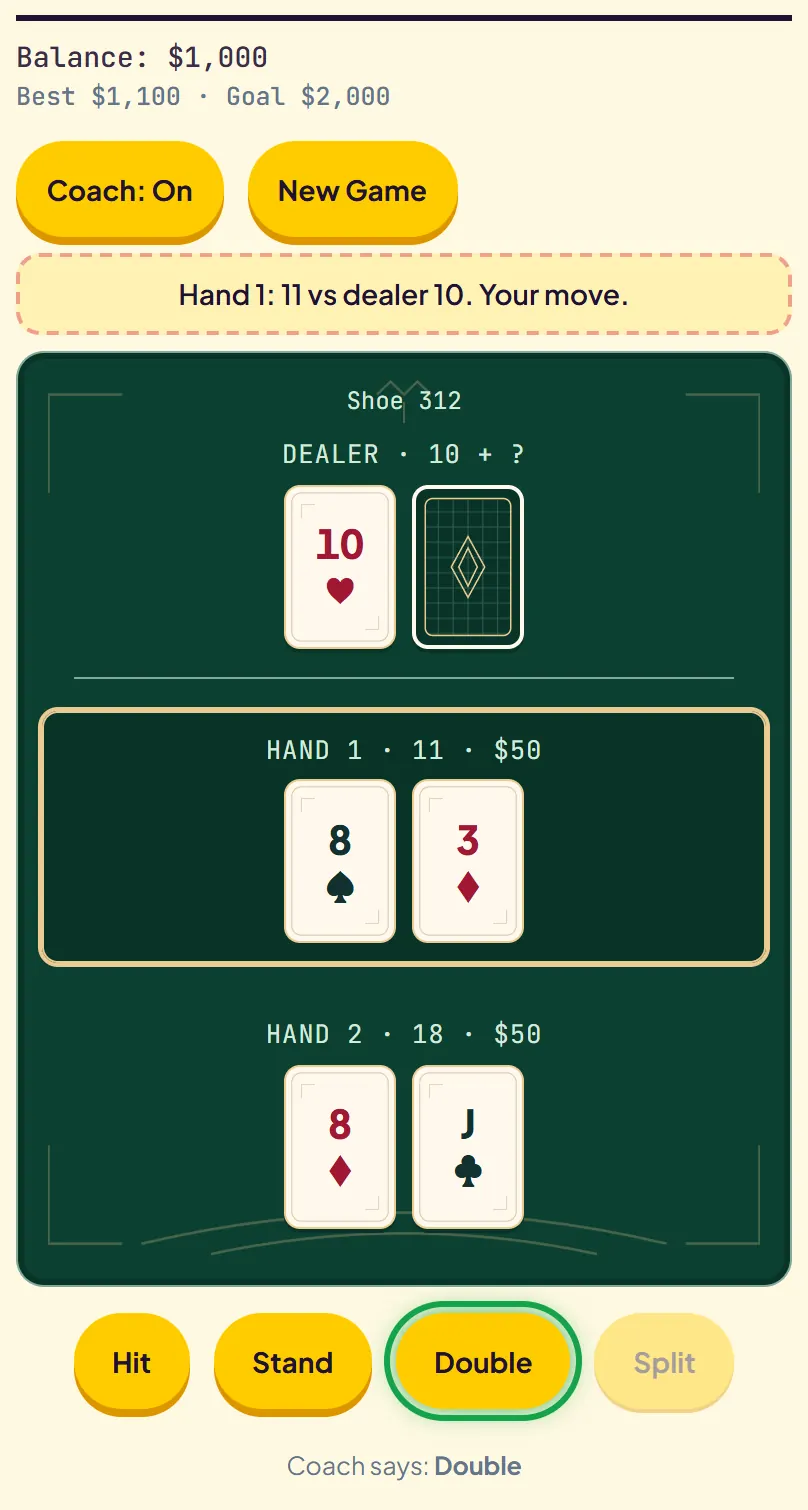
- Use double after split. If you split 8s and catch a 3, you have 11 against the dealer card, and the Double button is live. The chart's split rows for 2s, 3s, 4s, 6s and 7s assume this rule, which is why they split more often than charts for stricter tables.
- Double soft hands against 4, 5 and 6. A-2 through A-7 are the hands players most often under-play. They cannot bust on the next card, and the dealer is the one in trouble.
Advanced
- Know the soft 18 cells cold. A-7 against a 9, 10 or Ace is a hit. Players stand on 18 by reflex, but against those cards 18 loses more often than it wins, and a soft hand cannot bust on one card.
- Remember where doubling disappears. After a hit, "double" cells turn into "hit", except soft 18, which turns into "stand". The Coach handles this automatically; practise it with the Coach off.
- Size bets to the goal, not the last hand. From $1,000, flat $50 bets need 20 net wins to reach $2,000; flat $100 bets need 10. Bigger bets get you there in fewer hands and close the table faster when cards run cold. Raising your bet after losses does not change the odds of the next hand; the shoe has no memory of what you lost.
The Coach, Next Card Preview and Split & Double Lab
Coach. Tap "Coach: Off" to switch it on. The best move then glows green and a line under the buttons reads "Coach says: Double" (or Hit, Stand, Split). Whether the Coach is on or off, the game grades every decision you make against its strategy table, and the end-of-game screen shows the percentage you got right next to session peak, hands played, hands won, best ever stack and how many times you have beaten the house.
To learn fast, play ten hands with the Coach on, then turn it off and watch your Strategy percentage.
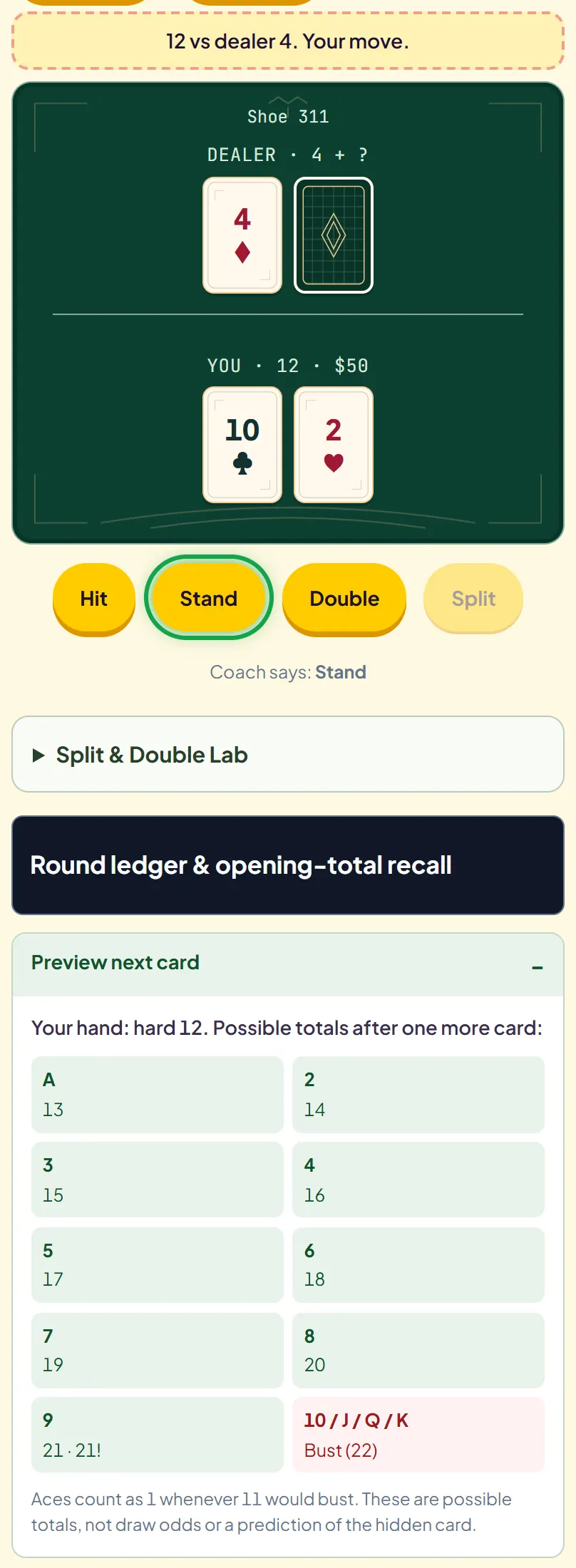
Next Card Preview. Under the table, "Preview next card" lists what your total would become with each possible next card: for hard 12, an Ace makes 13, a 9 makes 21, and any 10, Jack, Queen or King busts you at 22. It is a total calculator, not a prediction. It never looks at the shoe or the dealer's hole card, and the game says so right under the list.
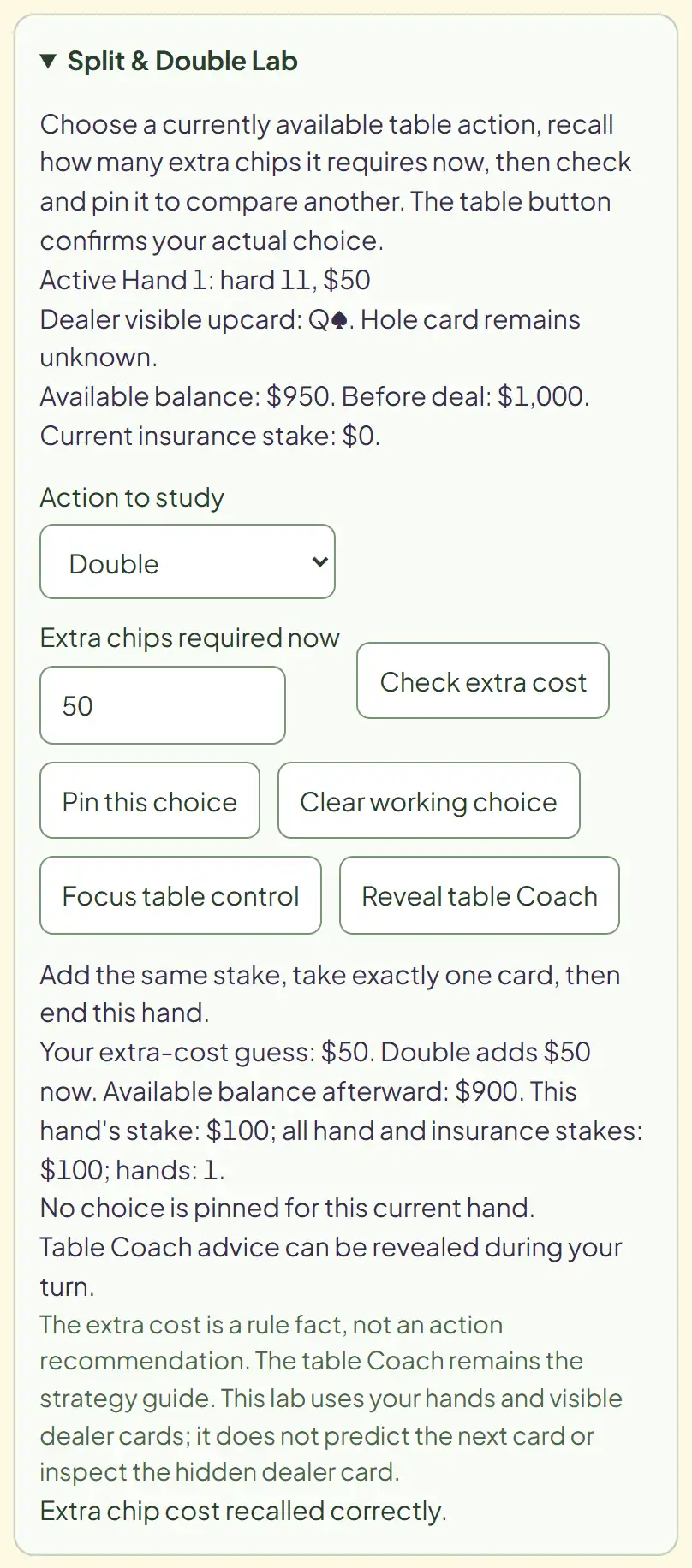
Split & Double Lab. This drop-down asks you to work out how many extra chips an action costs before you click it. On $50 with a balance of $950, a Double adds $50 and leaves $900. It also reminds you what each action does: Double adds the same stake, takes exactly one card and ends the hand. It explains rules only; strategy stays with the Coach. Below it, the Round ledger can quiz you after a hand on what your total was, and whether it was soft or hard, before your first move.
Saving. Your balance, chosen chip, best stack and Coach setting are stored on your device. Close the tab mid-climb and your stack is waiting when you return. New Game resets the stack to $1,000 but keeps your best and your houses-beaten count.
Common mistakes and the fix
| Mistake | Why it costs you | Fix |
|---|---|---|
| Standing on 12 to 16 against 7 or higher | The dealer usually makes 17 or more, so a stiff total loses unless they bust | Hit. You will bust sometimes; standing loses more. |
| Hitting 13 to 16 against 2 to 6 | You take the bust risk away from the dealer | Stand and let the dealer draw |
| Taking insurance on a good hand | About a 31% shot paying 2:1 | Always tap No thanks |
| Standing on soft 17 | 17 beats nothing the dealer can finish on | Hit, or double against 3 to 6 |
| Splitting 10s | Breaks up a 20, the second-best hand | Stand |
| Not splitting 8s against strong cards | Keeps the worst total in the game | Split 8s every time |
The stack runs dry faster than you thinkA $250 bet that you split and double on both hands needs $1,000 behind it. If you want to use every option, keep your bet at a quarter of your balance or less. When the balance hits $0, the table closes and the game starts over at $1,000.
FAQ
Is this real gambling?
No. The chips are pretend, there is no way to buy them, and nothing can be cashed out. It is a free 21 card game for practice and fun.
Does the dealer hit soft 17?
No. The dealer stands on all 17s, soft or hard, and the felt says so before the first deal. That rule is slightly in your favour compared with tables where the dealer hits soft 17.
Can I surrender?
No, this table does not offer surrender, so the chart above contains no surrender plays.
Why did my blackjack after a split only pay even money?
A 21 made after splitting is not a natural blackjack. Only an Ace and a ten as your first two cards, before any split, pays 3:2.
Are there keyboard shortcuts?
Yes: H hit, S stand, D double, P split, Y or N for insurance, 1 to 5 to pick a chip, and Enter or Space to deal.
Chart in hand? Turn the Coach off and see how close to 100% you can get before you reach $2,000.
Play Blackjack 21