Snap card game guide
How to play Snap online: rules, scoring and how to beat the speed-up
Snap is the card game where you shout "Snap!" when two cards of the same rank meet. This online version turns it into a one-player reflex test: two cards flip on every beat, you hit SNAP when the ranks match, and you have three hearts to protect. Here is exactly how it works, with the real numbers from the game, plus the habits that push a score into four figures.
Snap card game rules (the classic table version)
Traditional Snap is played with a standard deck by two or more players. The whole deck is dealt out face down, and nobody looks at their cards. Players take turns flipping the top card of their stack onto a face-up pile in front of them. Whenever the top cards of two piles show the same rank (two sevens, two queens), the first player to shout "Snap!" wins both piles and adds them to the bottom of their stack. Suits never matter. Calling snap when there is no match is usually penalized; a common house rule is giving a card to each opponent. A player who runs out of cards is out, and whoever ends up with the whole deck wins.
House rules vary a lot: some families use a shared center pile, some let you slap the piles instead of shouting, and the penalty for a false call changes from table to table. The core never changes, though: match the rank, ignore the suit, be first.
How to play Snap online here
You do not need a second player. Press Start and the game deals for you. After a short pause (700 ms) two cards flip face up side by side, and a yellow timer bar under them starts to drain. When it empties, the next pair flips. Your job each beat is one decision: do these two cards share a rank?
- Yes: tap SNAP!, tap the cards themselves, or press Space, Enter or S on a keyboard. All of them register on the press.
- No: do nothing. A non-matching pair simply goes away when the bar runs out.
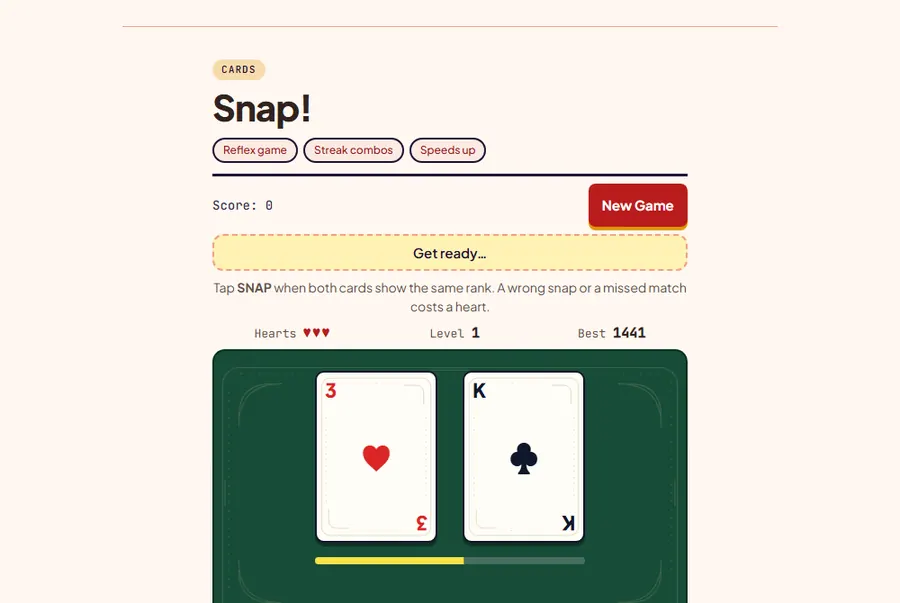
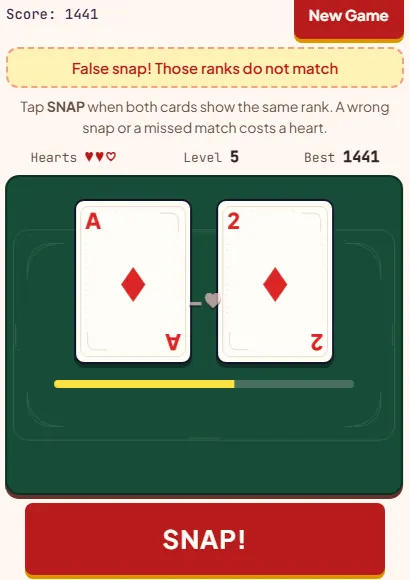
You start with three hearts. You lose one in two ways: a false snap (tapping when the ranks differ) or a missed match (letting a matching pair sit until the next deal arrives). Lose all three and the run ends. Only one penalty can happen per pair, so hammering the button on a wrong pair does not cost you three hearts at once, and extra taps after a good snap are ignored.
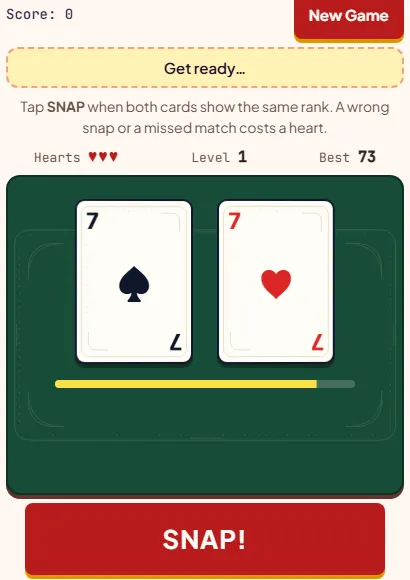
Matches are not rare, but they are not most pairs either. At level 1 about 34% of pairs match, and from level 2 on about 30%, so you will usually see two non-matches between snaps. When you do snap correctly, the next pair arrives 420 ms later instead of waiting out the bar, so good play speeds the game up.
How scoring works
Every correct snap is worth 10 points plus a speed bonus of up to 10. The bonus is based on how much of the beat was left when you tapped: snap the instant the cards appear and you get the full 10; snap as the bar runs out and you get close to 0. That total is then multiplied by your streak tier, and doubled again if the pair is golden.
| Snaps in a row | Multiplier | Points for a fast snap (18 base) | Same, on a golden pair |
|---|---|---|---|
| 1st and 2nd | x1 | 18 | 36 |
| 3rd to 5th | x2 | 36 | 72 |
| 6th to 9th | x3 | 54 | 108 |
| 10th and on | x4 | 72 | 144 |
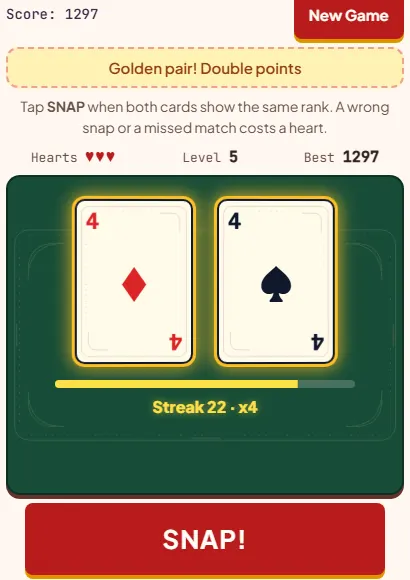
The 18 in the table is what a snap at about 234 ms earns on the first level's 1,300 ms beat (10 points plus an 8-point bonus). The best possible single snap is 20 points at x4 on a golden pair: 160. In a real run on this page, a golden pair of fours snapped at streak 23 added exactly 144 points.
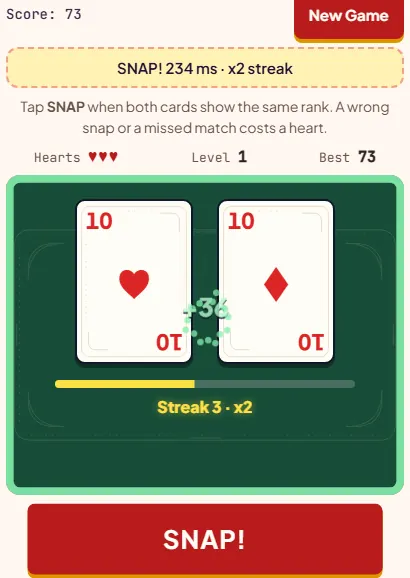
The streak is what really drives scores. Losing a heart, either way, resets it to zero and the multiplier back to x1. Three points follow from that. First, a single mistake costs far more than one heart: it can drop your snap value from 72 to 18. Second, missing a match on purpose is never a good idea, because it also costs a heart and breaks the streak. Third, a long clean run is worth more than a fast but sloppy one.
Golden pairs start appearing at level 2. About 15% of matching pairs from then on are golden: both cards glow and the status line says "Golden pair! Double points". They follow the same rules as any match. You still snap only because the ranks match, but they are worth twice as much.
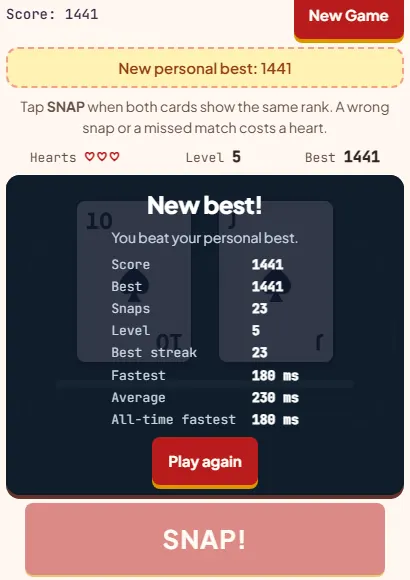
Your best score, best streak, fastest snap and number of runs are saved in this browser. The game-over screen also shows your snaps, level reached, fastest and average reaction for that run.
Levels, speed and look-alike cards
Every 5 correct snaps is a new level. Each level shortens the beat by 85 ms, from 1,300 ms at level 1 down to a floor of 560 ms, which you reach at level 10 after 45 snaps. Two things change at specific levels: golden pairs start at level 2, and at level 3 the game begins mixing in look-alikes.
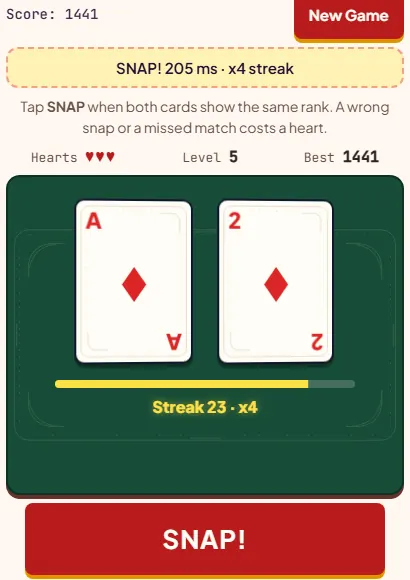
A look-alike is a non-matching pair built to fool you: same suit, neighboring rank, such as 7♦ and 8♦, Q♣ and K♣, or an ace beside a two or a king of the same suit. At a glance the two cards share a color, a suit symbol and nearly the same shape, and your thumb wants to go. At level 3, 35% of non-matching pairs are look-alikes. The share grows by 5 points a level and caps at 55% from level 7, so later in a run more than half of the "wrong" pairs are designed to trick you.
Strategy, from first run to four-figure scores
Beginner
- Read the corner, not the middle. Each card shows its rank in the top-left corner and its suit large in the middle. The big suit symbol is exactly the thing you are told to ignore. Train your eyes onto the two top-left corners.
- Accuracy before speed. A slow correct snap at level 1 still earns at least 10 points and keeps the streak. A fast wrong one costs a heart and the streak. Until you can get through level 2 cleanly, do not chase the speed bonus.
- Use the time you have. At level 1 the pair stays up for 1.3 seconds. That is plenty to read two ranks. Many early hearts are lost to panic taps in the first 200 ms.
Intermediate
- Say the rank in your head. "Seven... seven" beats "red... red". Naming the rank silently forces you to compare ranks rather than color or suit, which is what the look-alikes exploit.
- Protect the x4. Once you are on 10 or more snaps in a row, each snap is worth four times as much. Slow down slightly. Giving up a couple of speed-bonus points per snap is cheap compared with dropping back to x1.
- Know where decoys come from. Decoys are always the same suit. If the suits differ and the ranks look close, it is just an ordinary non-match. If the suits are the same, slow down: that is either a decoy or nothing at all, never a match. A real match always has two different suits.
Advanced
- Treat matching suits as a stop sign. Because a match always pairs one rank in two different suits, a same-suit pair can be skipped without reading the ranks at all. That rule alone defuses every look-alike.
- The speed bonus is relative. It is measured against the current beat. A 234 ms snap earns an 8-point bonus at level 1 but only 6 at level 10, where the beat is 560 ms. Late in a run the multiplier matters far more than your milliseconds.
- Trust the glow, then reset. Golden pairs only ever appear on true matches, so a glowing table is a safe snap. The risk is the pair after it: the next deal can be a same-suit decoy, and a thumb still excited from a big snap is quick to tap again. Read the next pair from scratch.
Common mistakes and how to fix them
- Snapping on color. Two red cards are not a match. Fix: read the corner ranks only.
- Snapping on suit. The look-alikes are always same-suit pairs. Fix: same suit means wait.
- Freezing on a real match. A match left on the table until the next pair flips costs a heart just like a false snap. Fix: when the ranks match, commit; do not double-check the suit.
- Chasing the bonus at high levels. The bonus is at most 10 points before the multiplier. Fix: on a long streak, take an extra moment.
- Tapping through the result. After a hit the next pair flips 420 ms later. A habit of tapping twice can land the second tap on the new pair. Fix: one press per snap.
Practice tools: Look-alike drill, Score & Heart Lab, Call Trail
Under the table are three extras. They never change your score, hearts or saved records.
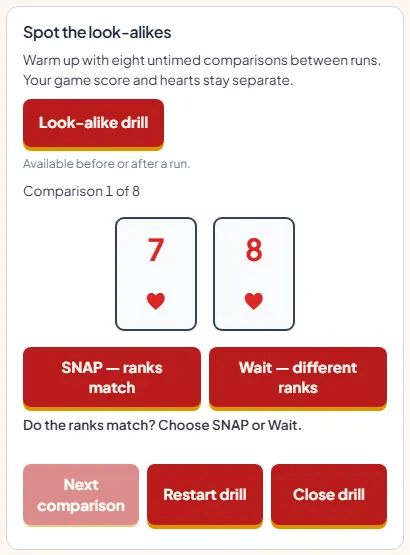
Look-alike drill. Eight untimed comparisons, available before or after a run. For each one you choose "SNAP — ranks match" or "Wait — different ranks", and the game explains the answer. The set mixes real matches like Q♥ with Q♠ against decoys like 7♥ with 8♥ and K♦ with Q♦. Run it once before a session if look-alikes keep catching you.
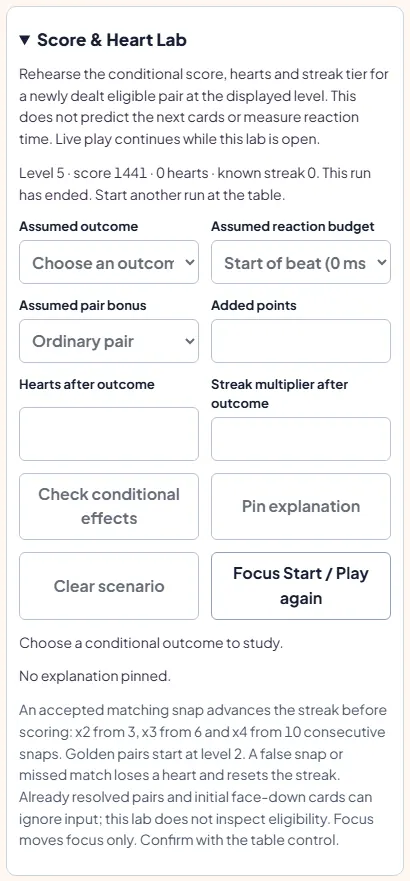
Score & Heart Lab. Pick an assumed outcome (matching snap, false snap or missed match), a reaction budget (start of the beat, half the beat, or the last millisecond) and whether the pair is golden. Then guess the points added, the hearts left and the streak multiplier, and check your answers against the real rules at your current level. It is the quickest way to feel how much a lost heart costs on a big streak.
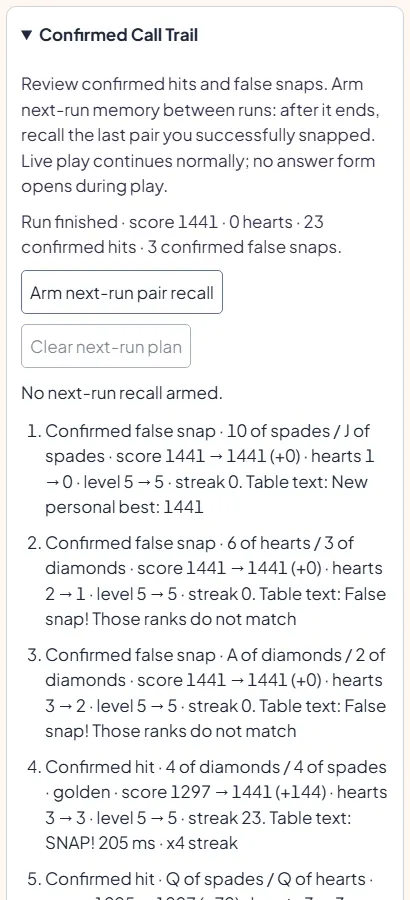
Confirmed Call Trail. A log of every confirmed hit and false snap from your runs, with the pair, score before and after, hearts and streak. You can also arm a next-run memory check, which asks you to recall the last pair you snapped after the run ends.
Snap FAQ
What are the basic rules of Snap?
Cards are turned face up one at a time, and when two showing cards have the same rank, the first player to call "Snap!" wins. Suits do not matter. In this online version both cards flip together and you tap SNAP instead of shouting.
Do the suits have to match?
No. Only the rank counts. In fact, a real match in this game always has two different suits, so a same-suit pair is never a match.
Can I play Snap online for free on my phone?
Yes. It runs in the browser on phones, tablets and computers, with no download or sign-up. Tap the SNAP button or the cards; on a keyboard use Space, Enter or S.
What happens if I miss a match?
If a matching pair is still on the table when the next pair is dealt, you lose a heart and your streak resets. You have three hearts per run.
How do I get a high score in Snap?
Build long streaks. From the 10th snap in a row every snap is worth four times as much, and golden pairs double that again. Avoiding mistakes matters more than raw speed.
Does Snap get faster?
Yes. Every 5 snaps is a new level and the beat shortens by 85 ms, from 1,300 ms to a minimum of 560 ms at level 10. Look-alike decoys start at level 3.
Read the corners, skip same-suit pairs, and protect that x4 streak.
Play Snap