Color Sort Rings guide
How to solve Color Sort Rings: the rules, the levels and a method that works
Color Sort Rings is a sort puzzle in the same family as the water sort puzzles you may know from tubes of coloured liquid. Instead of pouring water you move stacks of rings between pegs, but the logic is identical: you can only place a colour on a matching colour or on an empty spot, and every container holds four. This guide covers the exact rules from the game's code, how the levels grow from 3 colours to 8, how par and stars are worked out, and a step-by-step solving method, with Level 1 solved move by move in 7 moves (par is 10).
The rules
The board is a row of pegs. Each peg holds at most 4 rings. Every colour has exactly 4 rings, and there are always 2 empty pegs at the start. You win when every peg is either empty or holds 4 rings of one colour.
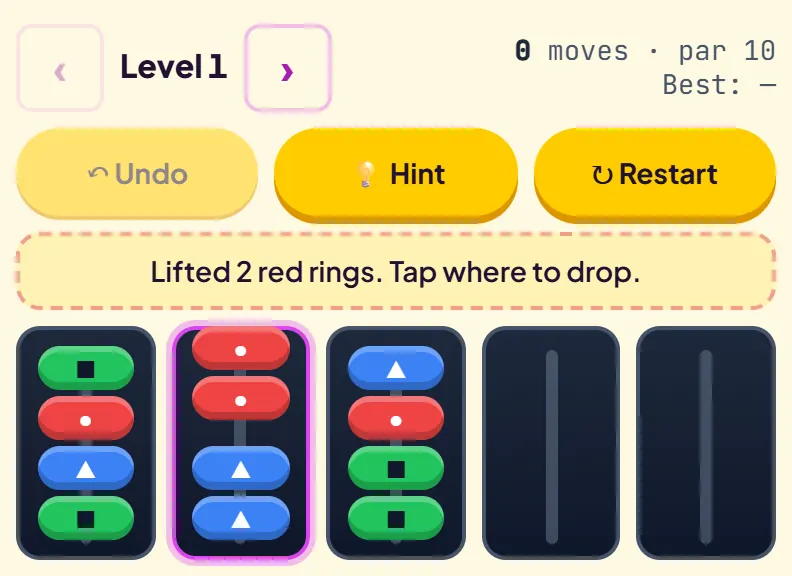
- Tap a peg to lift. You don't lift one ring, you lift the peg's top run: the top ring plus every ring of the same colour directly below it. Two reds on top of a blue means you're carrying two reds.
- Tap a target to drop. The target must be empty, or its top ring must be the same colour as the run you're carrying.
- As many as fit, move. If the target has room for fewer rings than you lifted, only that many move and the rest stay where they were. Moving 3 blues onto a peg holding 2 rings moves just 2.
- Changed your mind? Tap the same peg again (or press Esc) to put the rings back. Lifting and putting back is free and isn't counted as a move.
The game won't let you lift from an empty peg or from a peg that is already complete. A wrong drop shakes the peg and tells you why: either "That peg is full (4 rings max)" or a reminder of which colour has to match.
Every colour also carries a symbol, so you never have to rely on telling shades apart: red ●, blue ▲, green ■, yellow ◆, purple ★, orange ✚, cyan ♥ and pink ▼. On a keyboard, keys 1 to 9 select pegs 1 to 9 and 0 selects peg 10.
How the levels are built
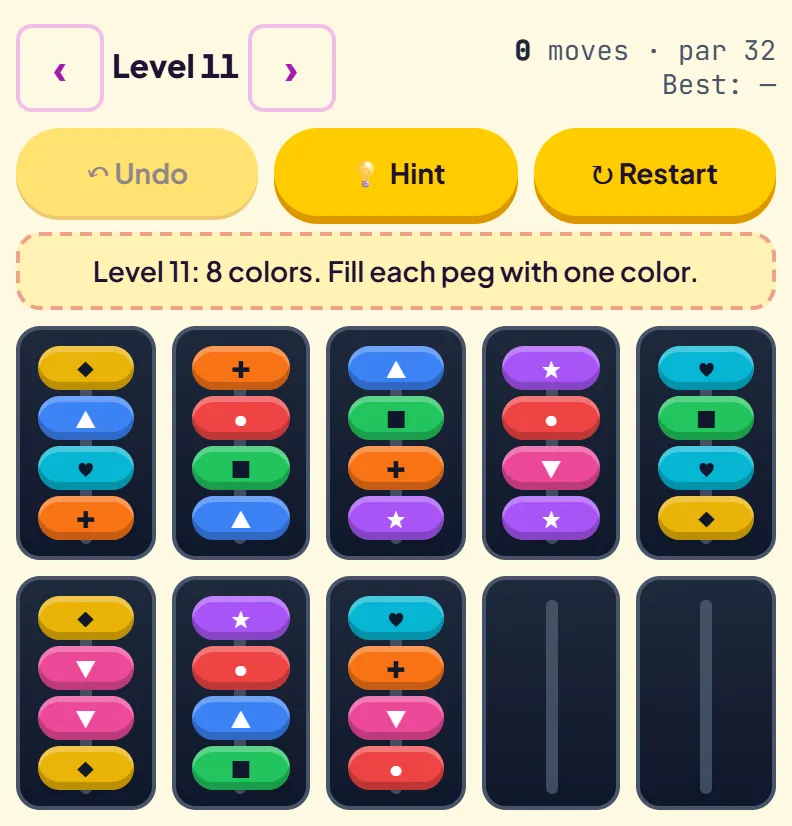
Levels are endless and the deals are fixed. The game generates each level from the level number, so everyone in the world gets the same Level 7. Level 1 starts with 3 colours, and one more colour is added every two levels until the cap of 8 colours at Level 11. There are always two spare pegs, so a level has colours + 2 pegs: 5 at the start, 10 from Level 11 on. With more than 6 pegs, the board wraps into two rows.
Two guarantees come with every deal. First, no peg starts with a run of 3 or more of one colour, so nothing is half-solved before you begin. Second, the game runs its own solver on the deal before showing it to you, so every level is solvable. If you're stuck, the position you made is the problem, not the deal.
| Level | Colours | Pegs | Rings | Par |
|---|---|---|---|---|
| 1 | 3 | 5 | 12 | 10 |
| 2 | 3 | 5 | 12 | 9 |
| 3 | 4 | 6 | 16 | 16 |
| 4 | 4 | 6 | 16 | 13 |
| 5 | 5 | 7 | 20 | 17 |
| 6 | 5 | 7 | 20 | 16 |
| 7 | 6 | 8 | 24 | 21 |
| 8 | 6 | 8 | 24 | 27 |
| 9 | 7 | 9 | 28 | 26 |
| 10 | 7 | 9 | 28 | 26 |
| 11 | 8 | 10 | 32 | 32 |
| 12 | 8 | 10 | 32 | 30 |
| 13 | 8 | 10 | 32 | 27 |
| 14 | 8 | 10 | 32 | 33 |
Notice that par doesn't rise smoothly. Level 8 has a higher par (27) than Level 9 (26) even though it has one colour fewer. Par comes from the solver's route through that specific deal, so some deals simply come out longer than others.
You unlock the next level by solving the current one. The ‹ and › arrows beside the level name move between any levels you've unlocked, and the game reopens on the level you were last on (after a win, that's the next one).
Moves, par and stars
Each drop is one move, no matter whether it carried one ring or three. That single fact changes how you should play: moving a run of 3 costs the same as moving 1, so big runs are cheap progress.
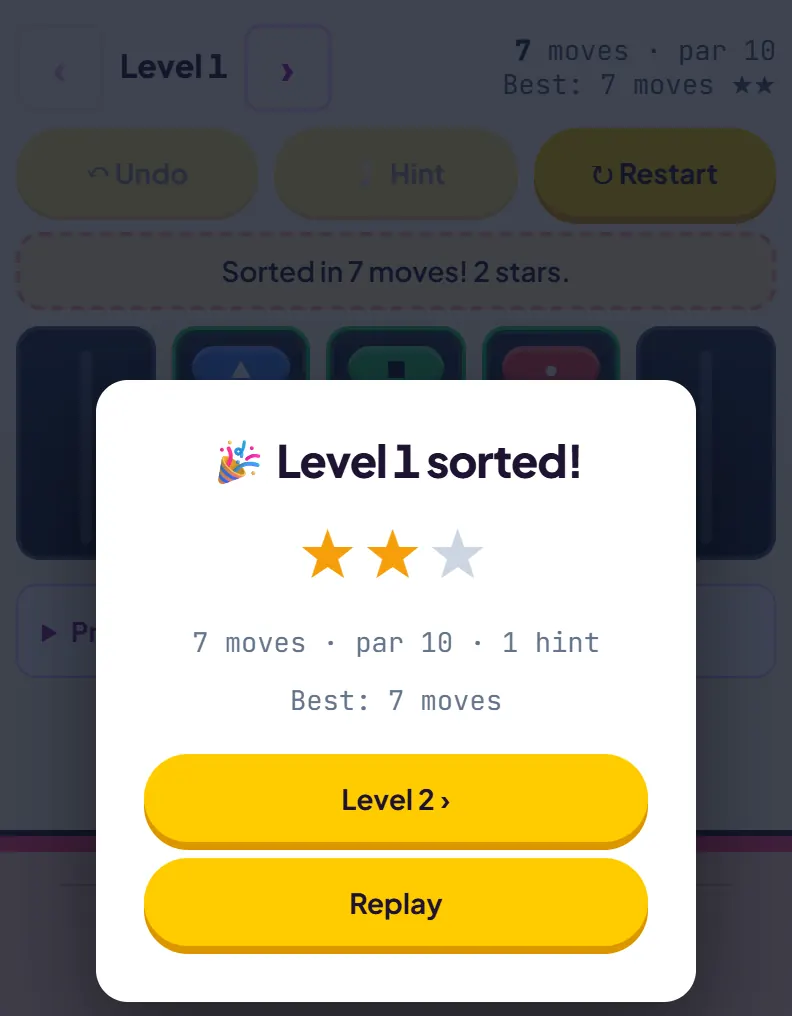
Par is the length of the solution the game's own solver found when it built the level. It is a reachable target, not the proven minimum. On Level 1 par is 10, but the level can be solved in 7, as shown below. Stars are then awarded like this:
- 3 stars: solved in par moves or fewer.
- 2 stars: solved in up to 1.5 × par, rounded up (15 moves on a par-10 level).
- 1 star: anything slower.
- Each hint costs a star, up to two, but a solved level always keeps at least 1 star.
Your best move count and best star rating are saved for every level, so you can come back and replay a level for a better score.
Undo, hints, restart and the transfer preview
- Undo (button, or U or Z) takes back your last move. It's unlimited and has no penalty.
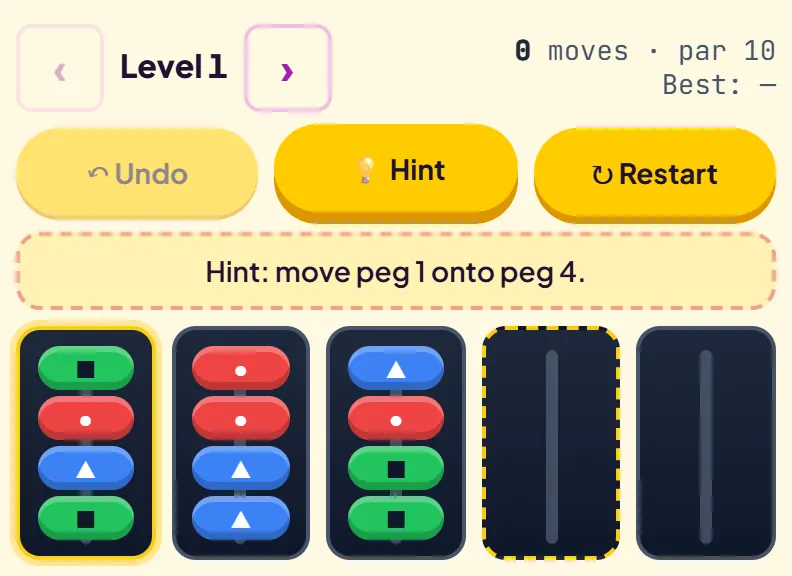
- Hint (button or H) runs the solver from your current position and highlights the move: the source peg glows gold and the target peg gets a dashed outline, with "Hint: move peg X onto peg Y" in the status line. If the solver can't find a way out from where you are, it says so and suggests undoing a few moves or restarting.
- Restart (button or R) resets the level, including the move and hint counts. Restarting clears a hint penalty, so if you took a hint early, restart and replay it clean.
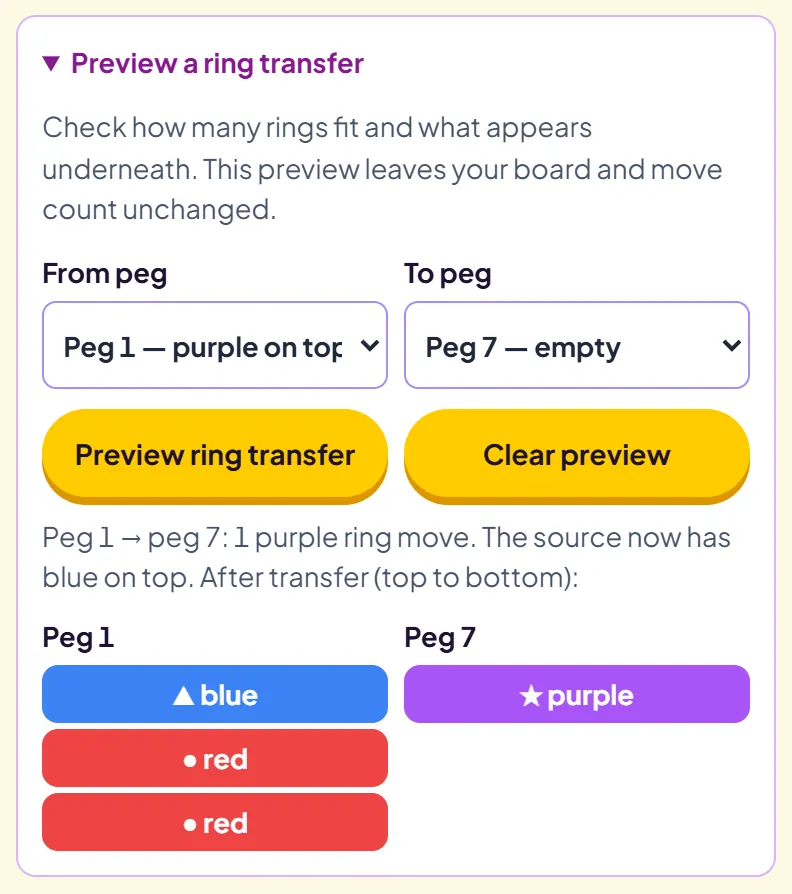
- Preview a ring transfer is a panel below the board. Pick a "from" peg and a "to" peg and it shows how many rings would move and what each peg would look like afterwards, without changing your board or move count.
The game also spots dead ends for you. If no useful move is left, the status line says "Stuck! No moves left. Undo or restart." and the Undo button nudges.
Worked example: Level 1 in 7 moves
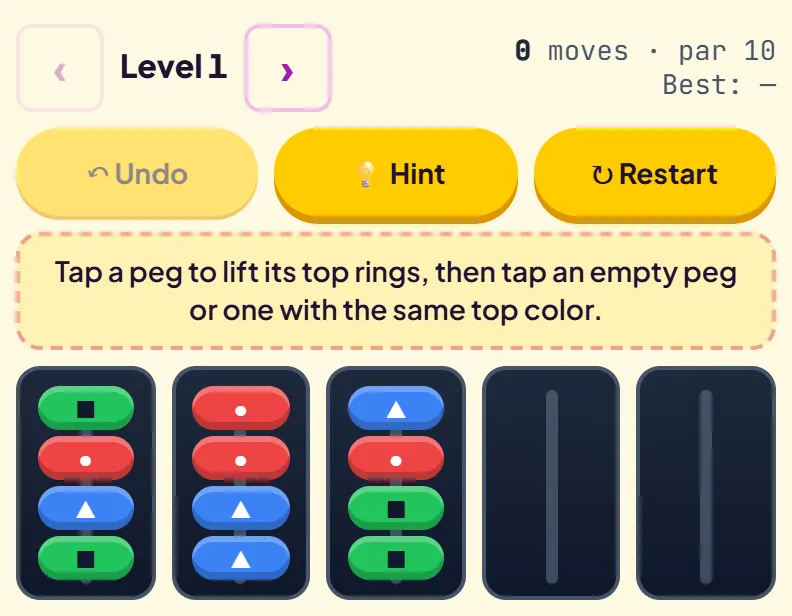
Here's the Level 1 deal, reading each peg from the top ring down:
- Peg 1: green, red, blue, green
- Peg 2: red, red, blue, blue
- Peg 3: blue, red, green, green
- Pegs 4 and 5: empty
Before touching anything, look at the bottoms. Peg 2 has two blues at the bottom and peg 3 has two greens at the bottom. Those are natural homes: if you can strip what's sitting on them, blue and green each have a half-built peg already. Red has no home at all, so red is the colour that needs an empty peg.
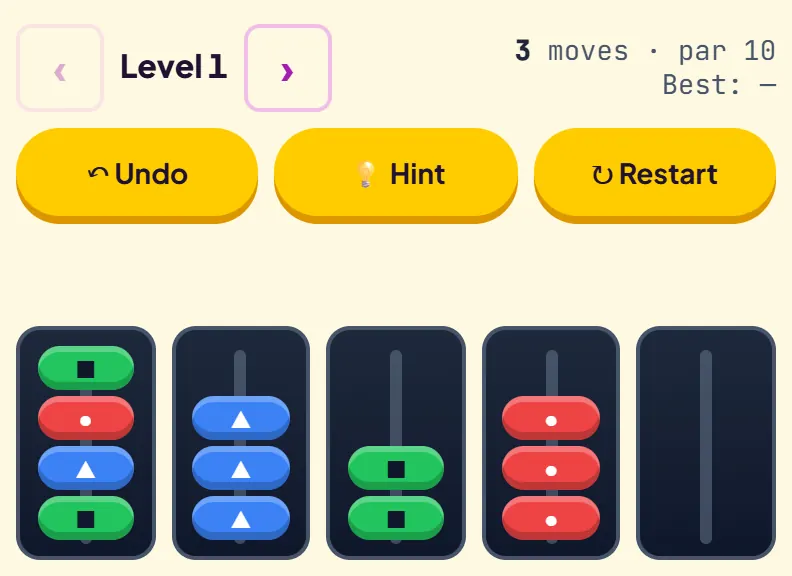
- Peg 2 → peg 4. Both reds move together to an empty peg. Peg 2 is now just its two blues.
- Peg 3 → peg 2. The blue from the top of peg 3 joins the blues. Peg 2: three blues.
- Peg 3 → peg 4. Now peg 3's top is red, which joins the reds. Peg 3 is down to its two greens. Peg 5 is still untouched.
- Peg 1 → peg 3. Green from peg 1 onto the greens: three greens.
- Peg 1 → peg 4. Red onto the reds. Red is complete.
- Peg 1 → peg 2. Blue onto the blues. Blue is complete.
- Peg 1 → peg 3. The last green completes green. Solved in 7, three under par, and peg 5 was never needed.
The pattern to take away: the first move cleared the top off a half-built home, and every move after that dropped onto a match. Notice too that the only empty peg used went to the colour with no home, and it went to a run of two, not a single ring.
A solving method, beginner to advanced
The same habits that solve Level 1 in 7 scale up to the 8-colour boards. Work through them in order.
- Read the bottoms first. The bottom ring of a peg is the hardest to move, so the colour already sitting there is the natural owner of that peg. Two or more of the same colour at the bottom is a home that's half done.
- Uncover homes before you fill empties. Your first moves should usually take whatever is sitting on a half-built home and put it somewhere useful. In Level 1, moving the reds off peg 2 opened a blue home and set up everything else.
- Give empty pegs to runs, not single rings. An empty peg holding two matching rings is halfway to complete. One holding a single ring is mostly a parking space, and you only have two.
- Prefer moves that land on a match. Dropping onto a same-coloured ring always makes progress and never uses up space you need. When you have a choice, take that kind of move.
- Move whole runs when you can. A run costs one move whatever its size. A partial move (when the target doesn't have room for the whole run) splits colours you already had together, so check the target has space first. The transfer preview tells you exactly how many will move.
- Finish colours early. A complete peg drops out of the puzzle completely: it can't be lifted again and it stops blocking anything. Fewer active pegs means fewer ways to go wrong.
- Treat the last empty peg as precious. With two empties you have room to work. With one you have to be careful. With none, every move has to land on a match. Before you use your last empty peg, make sure the move sets up a follow-up.
- Use undo instead of hints. Undo is unlimited and free, and hints cost stars. If you're unsure, try a line, look at the result, and undo back if it went nowhere.
- Chase par on a replay. Once you've solved a level, Restart and replay it with what you learned. Remember par is the solver's route, not the best possible one, so beating it is often realistic.
How players get stuck (Level 7 example)
Level 7 is the first 6-colour level (8 pegs, par 21). Here's a real line from its starting deal that ends in a dead end after only 6 moves. Each move looks reasonable on its own:
- Peg 1 → peg 7: a purple ring to an empty peg.
- Peg 6 → peg 8: a green ring to the other empty peg.
- Peg 5 → peg 7: another purple joins it.
- Peg 6 → peg 5: orange onto orange.
- Peg 7 → peg 6: both purples onto the purple on peg 6, which now has three. Peg 7 is empty again.
- Peg 1 → peg 7: a single blue onto the last empty peg.
After move 6, the top rings read red, orange, yellow, purple, orange, purple, blue, green. Both oranges and both purples sit on full pegs, and nothing else matches. There are no empty pegs left. The game calls it: "Stuck! No moves left."
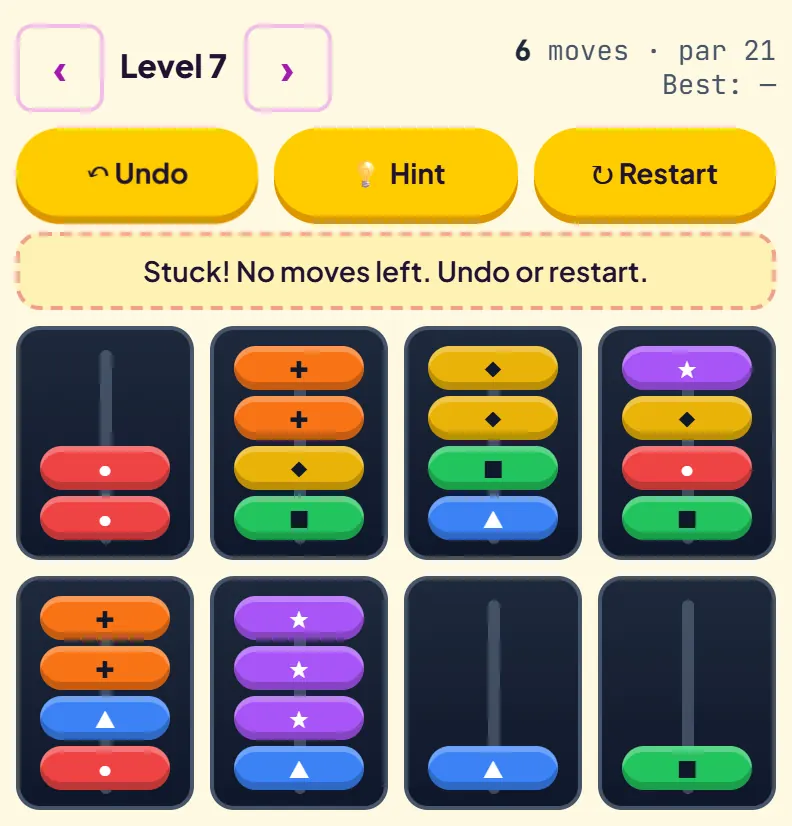
The fatal move was the last one. Before it, the position was still solvable, and the solver's line from there shows what to do with your last empty peg. Move the two oranges from peg 2 onto peg 7. That uncovers a yellow on peg 2, so peg 3's two yellows can drop onto it (three yellows). Then peg 5's two oranges join peg 7, and orange is complete. One empty peg spent on a two-ring run gave a finished colour within three moves. The same empty peg spent on a lone blue ended the game.
The rule from this: when you're down to one empty peg, only use it for a move that leads somewhere in the next one or two moves. If you can't name the follow-up, undo and look for a different move.
Common mistakes
- Filling both empties straight away. It feels like progress, but two parked single rings leave you nowhere to work.
- Forgetting that a run moves together. You can't split off one ring from the top of a matching pair. If you only wanted one, the target needs to have room for exactly one.
- Burying a half-built home. Dropping a different colour onto two greens at the bottom of a peg means you'll have to move it off again later. That's two wasted moves.
- Taking hints for small doubts. Each hint costs a star. Try the move, and undo if it's wrong. That costs nothing.
FAQ
Is Color Sort Rings the same as a water sort puzzle?
The rules are the same: 4 per container, move onto a matching colour or an empty one, sort every colour into its own container. Rings replace liquid, and a lift carries all the touching rings of the top colour, just as a pour carries all of the top colour. If you want the tube version, there's a separate Water Sort game on the site.
Can a level be impossible?
No. The game checks every deal with its own solver before you see it. A position you reach by playing can become a dead end, though, which is what undo and restart are for.
How many levels are there?
The levels are endless. Difficulty grows until Level 11, where boards reach their full size of 8 colours on 10 pegs, and every level after that is a new deal at that size.
Do hints always show the shortest solution?
No. A hint is the first move of a solution the solver finds from your position, which is a working route but not necessarily the shortest. On Level 1 its first suggestion differs from the 7-move line in this guide.
Does undo cost anything?
No. Undo is unlimited and removes the move from your count. Only hints cost stars, and Restart resets both the moves and the hint count.
Can I play without telling colours apart?
Yes. Each colour has its own symbol (● ▲ ■ ◆ ★ ✚ ♥ ▼), and screen readers announce each peg's ring count and top colour.
Level 1 is waiting. Try the 7-move line above, then see if you can beat par on Level 3.
Play Color Sort Rings