Bubble Wrap guide
Virtual bubble wrap that plays two ways: a calm sheet and a 30-second race
This is a sheet of bubble wrap on your screen. Tap a bubble and it pops with a little burst of sound. Press and slide, and you pop a whole row in one stroke. Zen mode has no clock pressure and no way to lose. Rush 30s turns the same sheet into a score attack, with combos, gold bubbles and purple bubbles that take two touches. Below you'll find exactly how both modes work, how Rush scoring is calculated, and why so many people keep a tab like this open for a two-minute break.
How to play: tap, slide, clear
There are only two gestures. Tap a bubble to pop it. Press and slide to pop every bubble your finger (or mouse pointer) passes over. A popped bubble goes flat and grey with a dashed ring, so you can always see what's left. Popped bubbles can't be popped again, and a slide never hits the same bubble twice in a row.
The sheet is built from bubbles at least 44 pixels across with a 4-pixel gap, which is a comfortable fingertip target. The game fits between 4 and 8 columns to your screen width and then adds rows until the sheet holds about 64 bubbles. On most phones and every desktop that means a neat 8 by 8 grid of 64. On narrower screens you get something like 7 by 9 (63) or 6 by 11 (66), so the count stays within a couple of bubbles either way.
Above the sheet you pick a mode, Zen or Rush 30s. The game remembers which one you used last. New Game lays a fresh sheet at any moment, even halfway through.
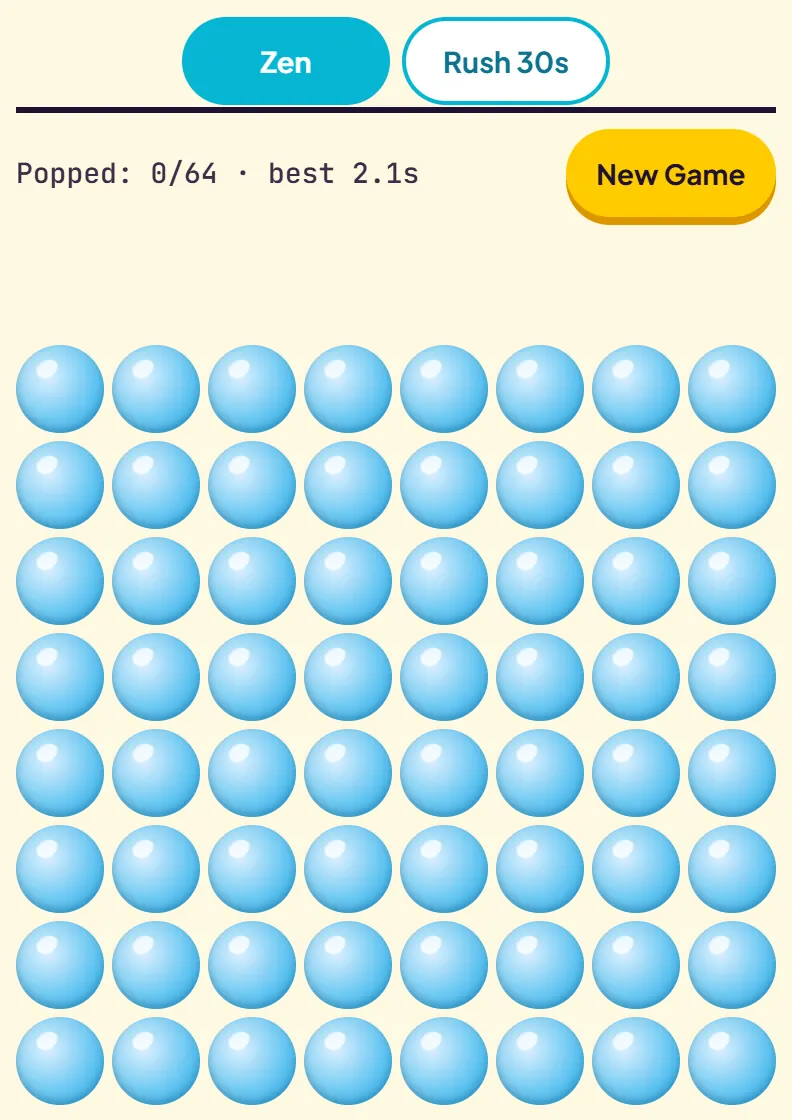
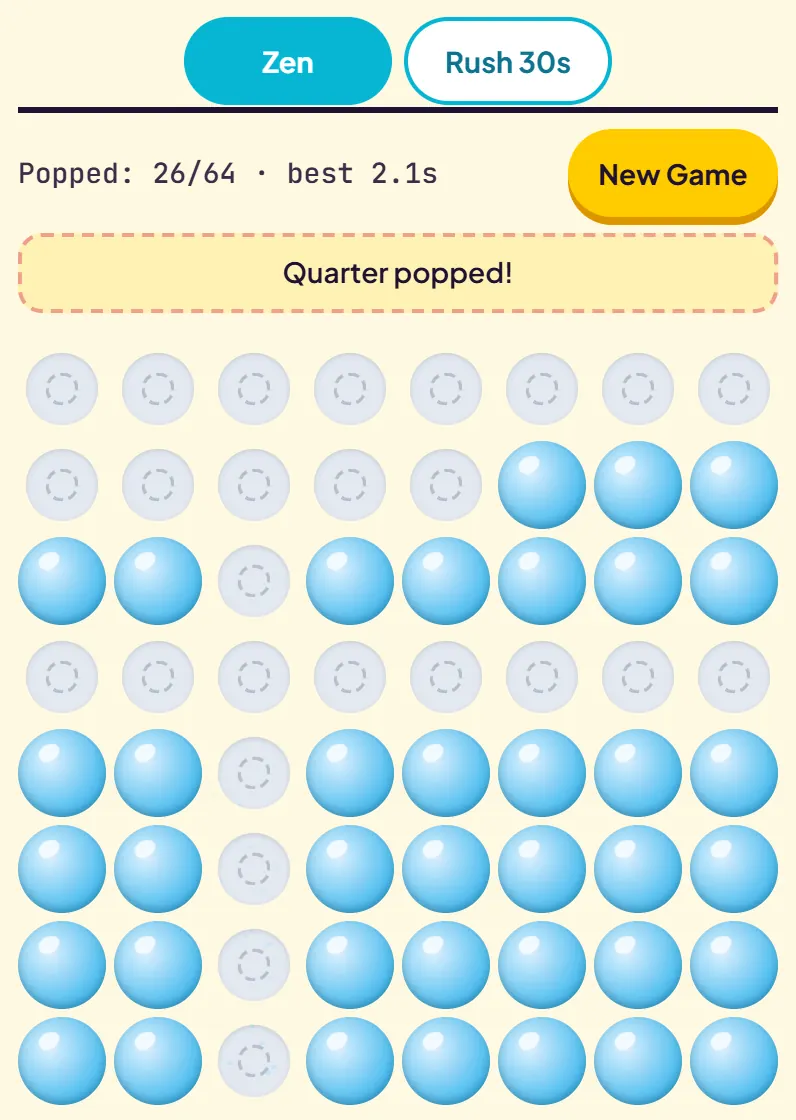
Zen mode, step by step
Zen is the mode the page opens in on a first visit, and it is the closest thing to a real sheet of bubble wrap. There is no score, no combo and nothing you can fail.
- Pop anywhere. Your first pop starts a quiet timer in the background. Nothing on screen counts down.
- Watch the milestones. At 25%, 50% and 75% of the sheet the banner says "Quarter popped!", "Halfway there!" and "Almost clear!". They are small markers, not deadlines.
- Clear the last bubble. The sheet-cleared card shows how many bubbles you popped and your clear time to a tenth of a second, plus your lifetime total across every sheet and round you have played.
- Go again or switch. "Pop Another Sheet" lays a new sheet. "Try Rush" switches modes.
Your fastest clear time is saved as your Zen best and shown next to the counter. The timer pauses if you open the site menu or switch to another tab, so stepping away mid-sheet never wrecks a time. If you don't care about times at all, ignore it. Zen works fine as an endless supply of things to pop.
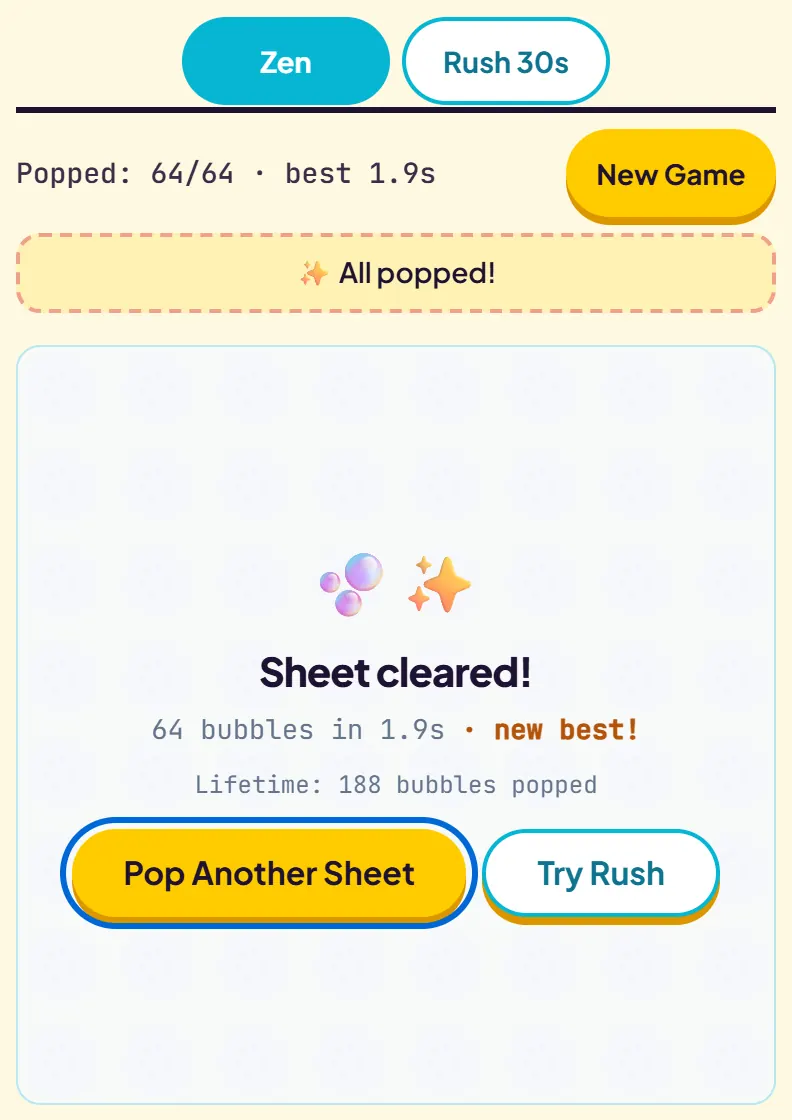
Rush 30s: the score attack
Rush uses the same sheet but adds a 30-second clock, shown as a bar above the board. The clock does not start when you choose the mode. It starts on your first pop, so you can get your hand in position first. The banner says "Pop any bubble to start the clock" until you do.
Three bubble types appear in Rush:
- Blue bubbles are worth 1 point each.
- Gold bubbles are worth 5 points and add 1.5 seconds to the clock. The first sheet has 2 of them and every later sheet has 3.
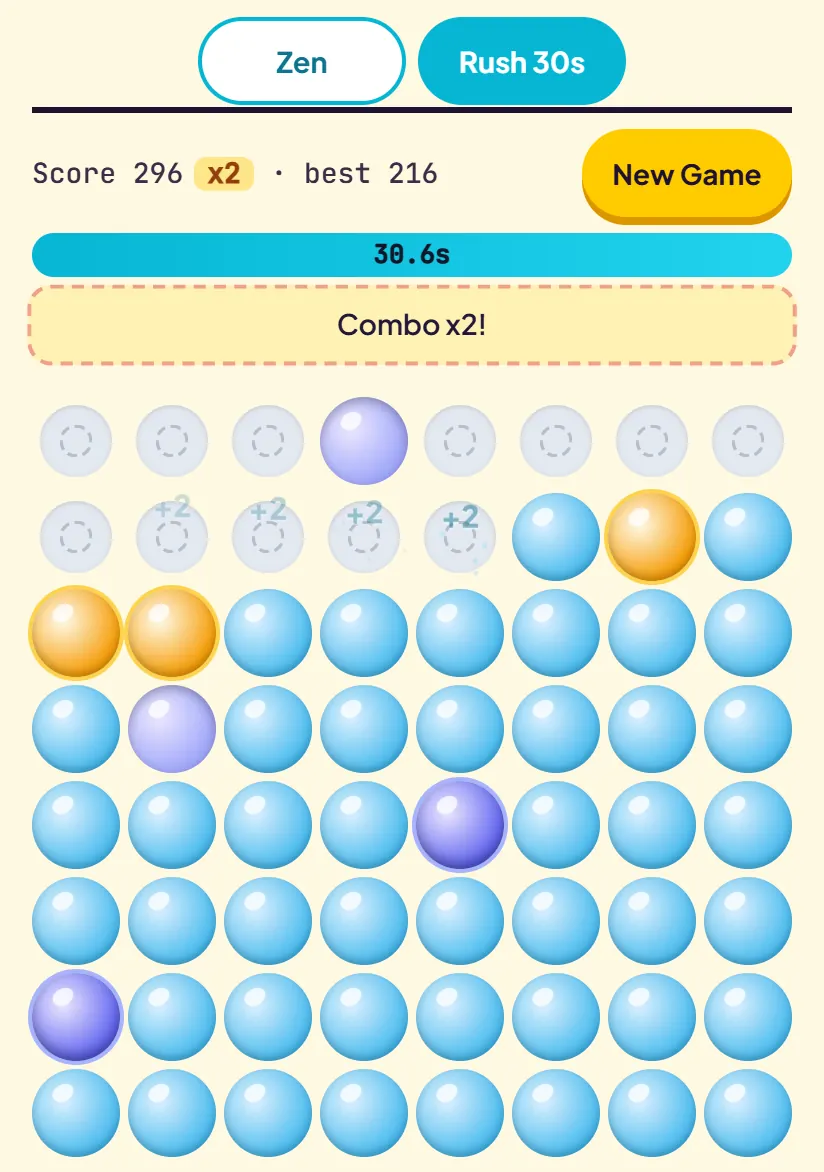
- Purple (tough) bubbles need two separate touches. The first touch only dents them (they turn pale lavender). The second pops them for 2 points. None appear on sheet 1. Each new sheet adds 4 more, up to a cap of 16.
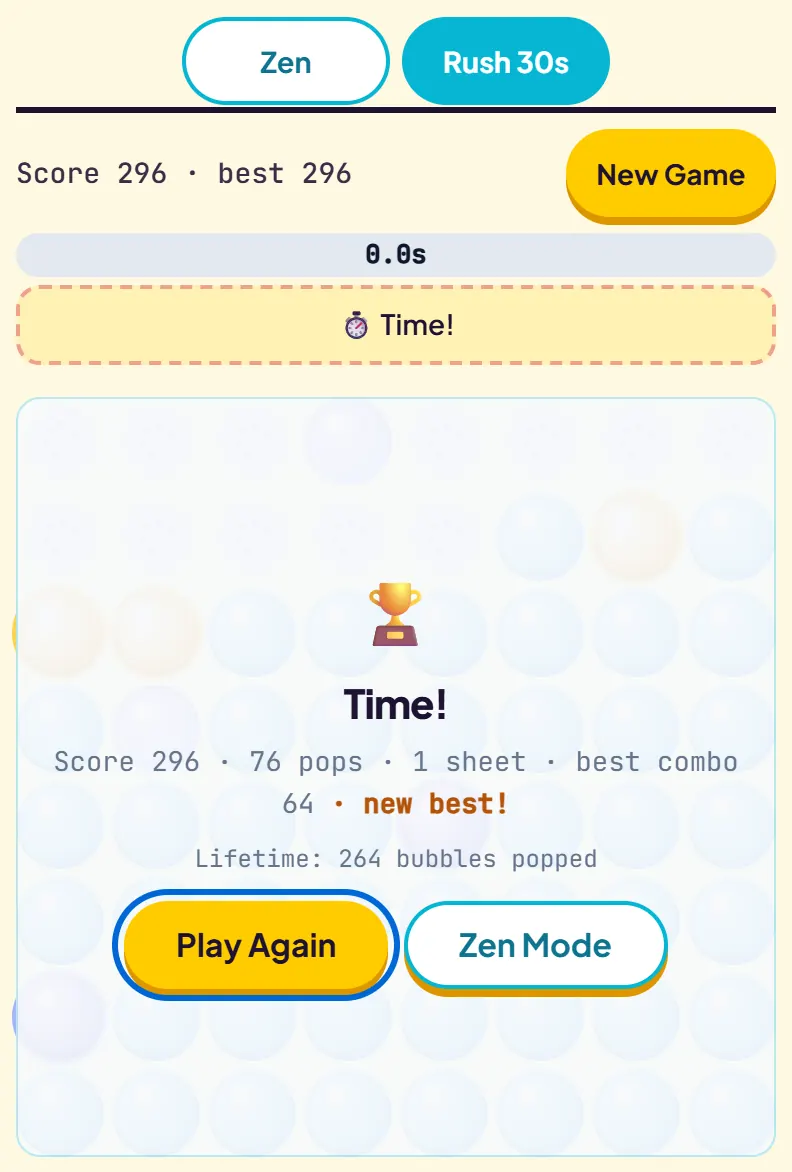
Clear the whole sheet and you get 2 extra seconds, then a new sheet slides in after a pause of about a quarter of a second. The bar turns to its warning style in the last 5 seconds, and the banner counts "3…", "2…", "1…" before time runs out. The results card then shows your score, total pops, sheets cleared and your best combo.
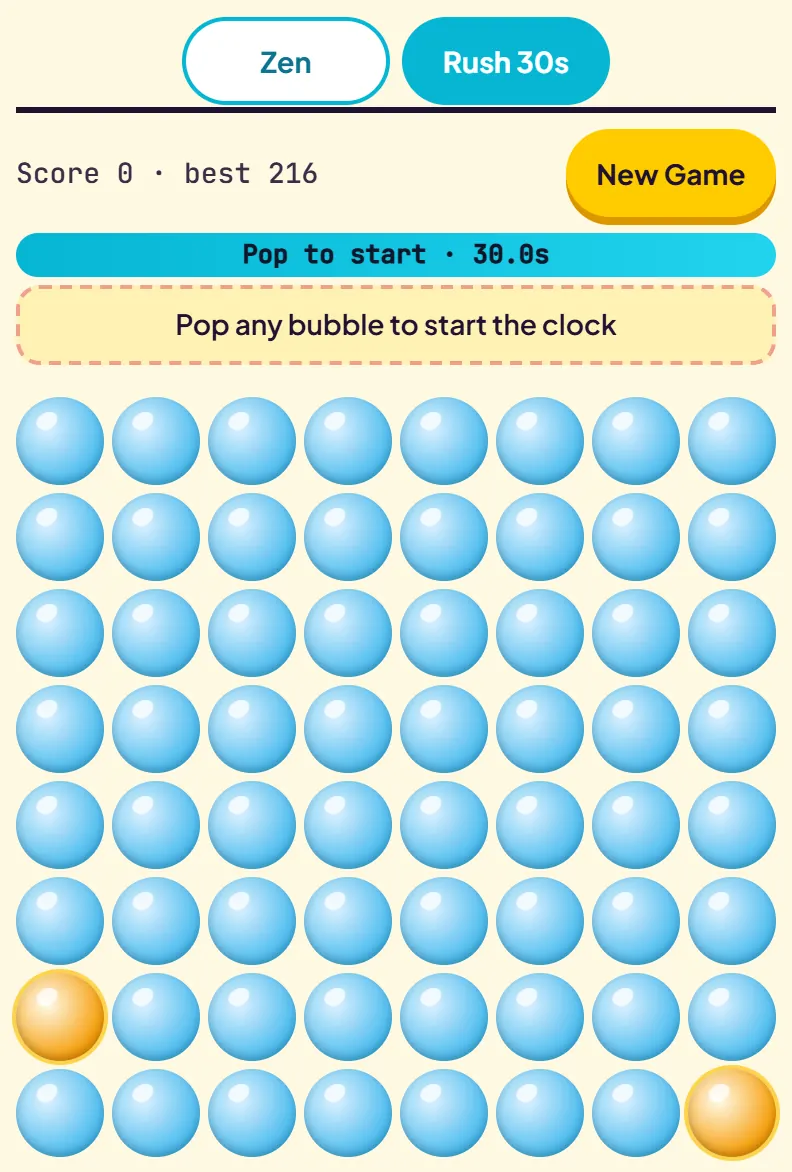
How Rush scoring works
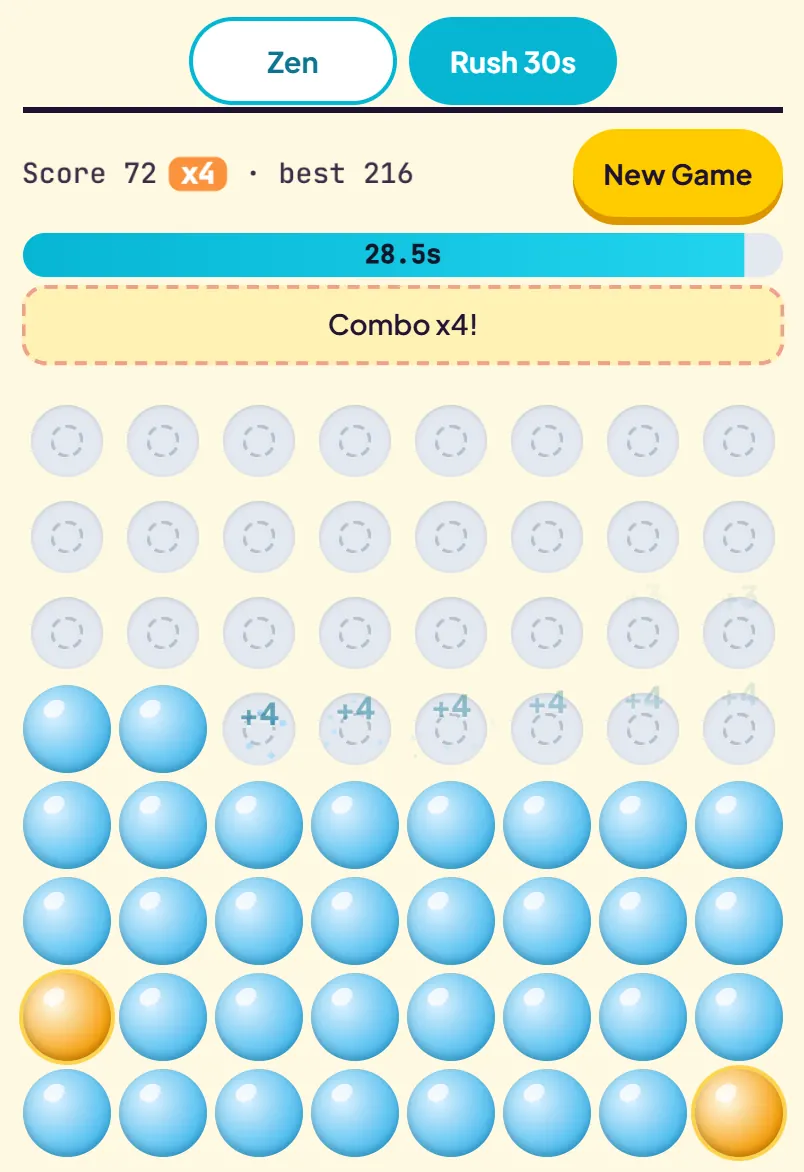
Every pop in Rush earns its base value (1, 2 or 5) times the current multiplier. The multiplier comes from your combo, which is a count of pops chained together with less than 0.45 seconds between each one. Leave a longer gap and the combo drops back to zero.
The multiplier climbs one step for every 8 chained pops and tops out at x5:
| Pop number in the chain | Multiplier | Blue bubble | Purple bubble | Gold bubble |
|---|---|---|---|---|
| 1 to 8 | x1 | 1 | 2 | 5 |
| 9 to 16 | x2 | 2 | 4 | 10 |
| 17 to 24 | x3 | 3 | 6 | 15 |
| 25 to 32 | x4 | 4 | 8 | 20 |
| 33 and up | x5 | 5 | 10 | 25 |
Run the numbers on a single unbroken slide across 64 blue bubbles: 8 points from the first eight, then 16, 24 and 32 from the next three blocks of eight, then 32 bubbles at x5 for 160. That's 240 points from one sheet. Stop and restart halfway, and the same 64 bubbles are worth only 2 × 80 = 160. The chain is worth more than the bubbles themselves.
| Sheet | Gold bubbles | Purple (two-touch) bubbles | Time bonus for clearing |
|---|---|---|---|
| 1 | 2 | 0 | +2 s |
| 2 | 3 | 4 | +2 s |
| 3 | 3 | 8 | +2 s |
| 4 | 3 | 12 | +2 s |
| 5 and later | 3 | 16 (cap) | +2 s |
Rush strategy, beginner to advanced
Everything in Rush comes back to one idea: keep the chain alive and keep the clock topped up. Here's how, roughly in the order players figure it out.
- Slide, don't tap. Tapping 64 bubbles fast enough to keep every gap under 0.45 seconds is hard work. A slide pops each bubble the instant your finger crosses it, so a steady drag keeps the gaps tiny without any effort.
- Snake through the rows. Go left to right on row 1, drop down, right to left on row 2, and so on. Every bubble sits next to the one before it, so you never leave a gap long enough to break the chain.
- Don't lift your finger at the end of a row. Lifting and putting it back down usually takes longer than 0.45 seconds once you include aiming. Curve around the end of the row instead.
- Get gold late in the chain, not early. A gold bubble is 5 points at x1 but 25 at x5, and the 1.5-second bonus is the same either way. If your snake path reaches the gold after pop 33, you get five times the value. Don't break the chain to get there, though. Gold is a bonus, the chain is the engine.
- Clear sheets for the time. Each full sheet adds 2 seconds and gold adds 1.5. A sheet with 3 golds and a clear is worth 6.5 extra seconds, more than a fifth of your starting clock. Players who leave five stray bubbles behind lose that bonus completely.
- Dent purple bubbles on the way past. When your slide crosses a purple bubble it gets dented, not popped. That's fine. It doesn't add to your combo, but it doesn't end the slide either.
- Swing back through the dents in the same slide. The game only refuses to hit the same bubble twice in a row. Once you've passed other bubbles, sliding back over a dented one pops it. Flat bubbles you cross on the way back are ignored, so they won't get in the way. Finish your snake, then trace a path back through the pale purple bubbles without lifting.
- Expect the chain to reset at a new sheet. When a sheet clears, your slide is cut off and the board locks for about 0.26 seconds while the next sheet appears. Only about 0.19 seconds remain of the 0.45-second combo window, so in practice every sheet starts a fresh chain. Plan each sheet as its own 64-pop run.
- Use the opening. The clock waits for your first pop. Put your finger on a corner bubble, take a breath, then go. A clean first sheet with both golds sets up the whole round.
Why popping feels calming, and how to use it
Real bubble wrap was invented in 1957 by two engineers, Alfred Fielding and Marc Chavannes, who were originally trying to make textured wallpaper. It ended up as packaging, and people have been popping it ever since. A virtual sheet can't copy the feel of plastic, but it copies the parts that make the habit satisfying.
- Every action gets an instant answer. Each pop plays a short burst of sound made fresh for that pop (filtered noise plus a low thump), shows a few particles and, on phones that support it, gives a tiny vibration. Pitch varies a little from pop to pop, so it doesn't drone.
- Visible progress. The counter, the flat grey bubbles and the milestone messages show the job shrinking. A sheet is about 64 pops, so it ends quickly and cleanly.
- Nothing to lose. Zen mode has no failure state and no visible clock. You cannot do it wrong.
- Your hands are busy, your head is free. Popping takes almost no thought, which is why it works as a fidget.
Ways people use it in practice:
- A two-minute reset between tasks. Clear one Zen sheet, then go back to work. The sheet ending is a natural stop, which a social feed never gives you.
- Something to do with your hands on a call. Mute the site (the speaker button in the top bar) and keep the vibration, or use a desktop with the sound off. Slides are silent with sound muted.
- Waiting rooms and queues. It needs no reading, no audio and no concentration, so you can drop it the second your name is called.
Note: this is a toy, not a treatment. If stress or anxiety is affecting your daily life, talk to a doctor or another qualified professional. A sheet of bubbles is just a pleasant break.
If you prefer motion settings turned down, the game respects your device's "reduce motion" setting: it skips the particle bursts and the bouncing animations and keeps everything else.
Common mistakes
- Tapping in Rush. Taps leave gaps, gaps break combos, and a broken combo throws away most of your points. Slide.
- Lifting at row ends. The 0.45-second window is shorter than it sounds. Curve, don't lift.
- Chasing gold across the board. Jumping from your path to a gold bubble usually costs more chain value than the gold returns. Route your path through it instead.
- Trying to pop a purple bubble by holding still on it. Holding does nothing. It needs a second, separate hit, either a new tap or a slide that comes back to it after crossing other bubbles.
- Leaving strays. The 2-second sheet bonus only pays when the sheet is completely empty. Scan for the last blue dot before the clock runs out.
Saves, sound and the pixel studio
The game saves to your browser on this device: your best Zen clear time, your best Rush score, your lifetime bubble count, sheets and rounds played, and which mode you used last. There's no account, and nothing is uploaded. If you clear your browser data, those records reset.
Sound follows the site's mute and pause buttons. The pop sound is only created after your first touch, as browsers require. In Rush, the pop gets slightly higher as your multiplier rises, gold bubbles ring with a rising chime, and a dent makes a duller, lower knock. You can hear how a run is going without looking at the score.
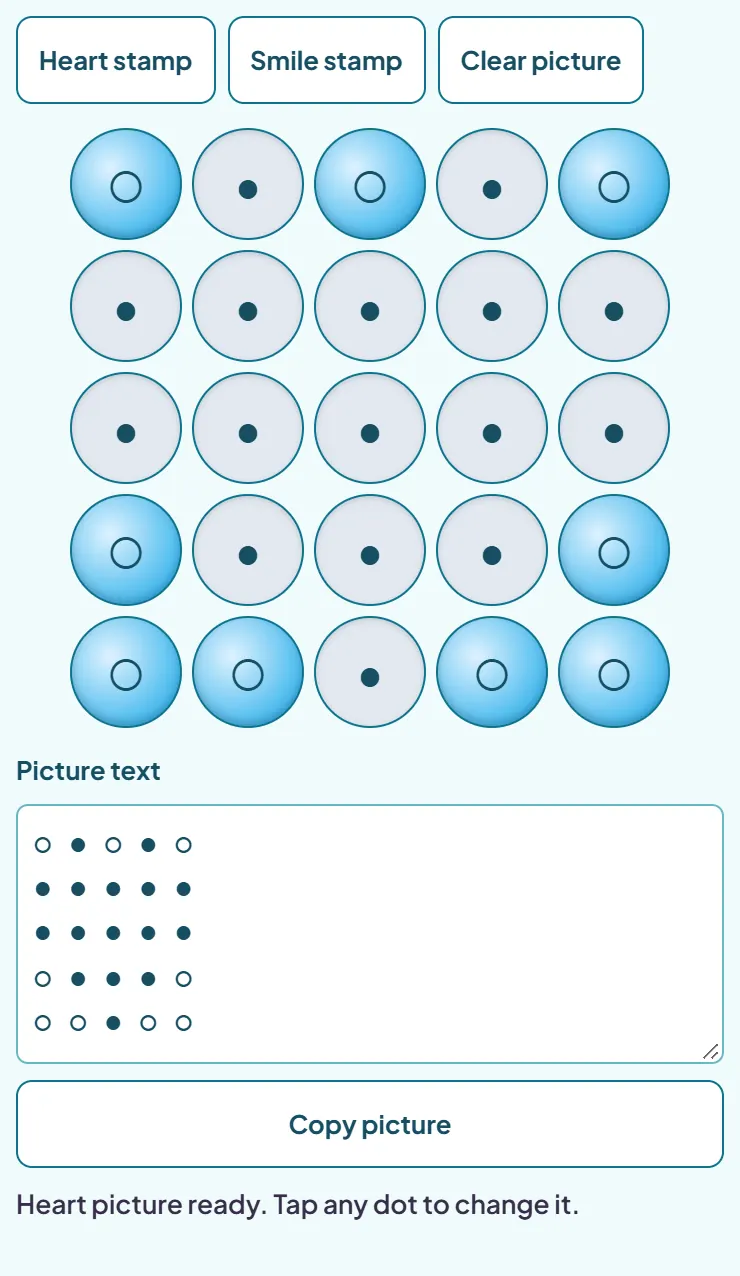
Under the game there's a small extra called the Bubble pixel studio: a 5 by 5 grid of bubbles where you tap dots to pop or refill them, with a heart stamp, a smile stamp and a clear button. It turns your design into dot text you can copy into a message. Pictures last for the visit only and never touch your Zen or Rush records.
Keyboard players can Tab to any bubble and press Enter or Space to pop it, in either mode and in the studio.
FAQ
Is there a real end to the bubbles?
Each sheet holds about 64 bubbles and ends when you clear it, but you can lay a new sheet as often as you like with New Game or Pop Another Sheet. The supply is unlimited.
What's a good Rush score?
Plain bubbles alone are worth up to 240 points a sheet if you chain the whole sheet, and gold at x5 adds 25 each. So clearing sheet 1 in one chain, with both golds collected after pop 33, is worth 280 (240 for the sheet, plus 20 extra for each gold). Scores beyond that come from clearing more sheets, where purple bubbles slow you down but pay double.
Why did my combo reset even though I was popping fast?
Either a gap between two pops went over 0.45 seconds (often at the end of a row, or when hitting a purple bubble's first dent, which doesn't count as a pop), or a sheet just cleared. A new sheet always pauses for about a quarter of a second, which nearly always ends the chain.
Do purple bubbles appear in Zen mode?
No. Zen sheets are all plain bubbles. Gold and purple bubbles, the combo and the clock exist only in Rush.
Does the timer keep running if I switch tabs?
No. In Zen the clear-time timer pauses while the tab is hidden or the site menu is open. In Rush the clock runs on the page's animation loop, which stops when the tab is hidden or the game is paused, and a single frame can never eat more than a tenth of a second.
Can I play without sound?
Yes. Use the speaker button in the top bar to mute. Popping still shows its particles and, on phones that support it, a light vibration.
A fresh sheet is waiting. Try one calm Zen sheet, then see how long a chain you can hold in Rush.
Play Bubble Wrap